

In Part I, I examined how leaders in high-control wellness spaces often respond to dissent by shaping narrative and public perception.
This piece looks at something quieter—and in many ways, more revealing: how rules, boundaries, and “sovereignty” are used to enforce loyalty while appearing voluntary.
The screenshots below come from the latter half of the same mass email previously referenced. They are presented for behavioral analysis only. Names are omitted.
Rules That Only Flow One Way
Rules are not inherently problematic. Every healthy group has them.
What matters is how rules are framed, and who is subject to them.
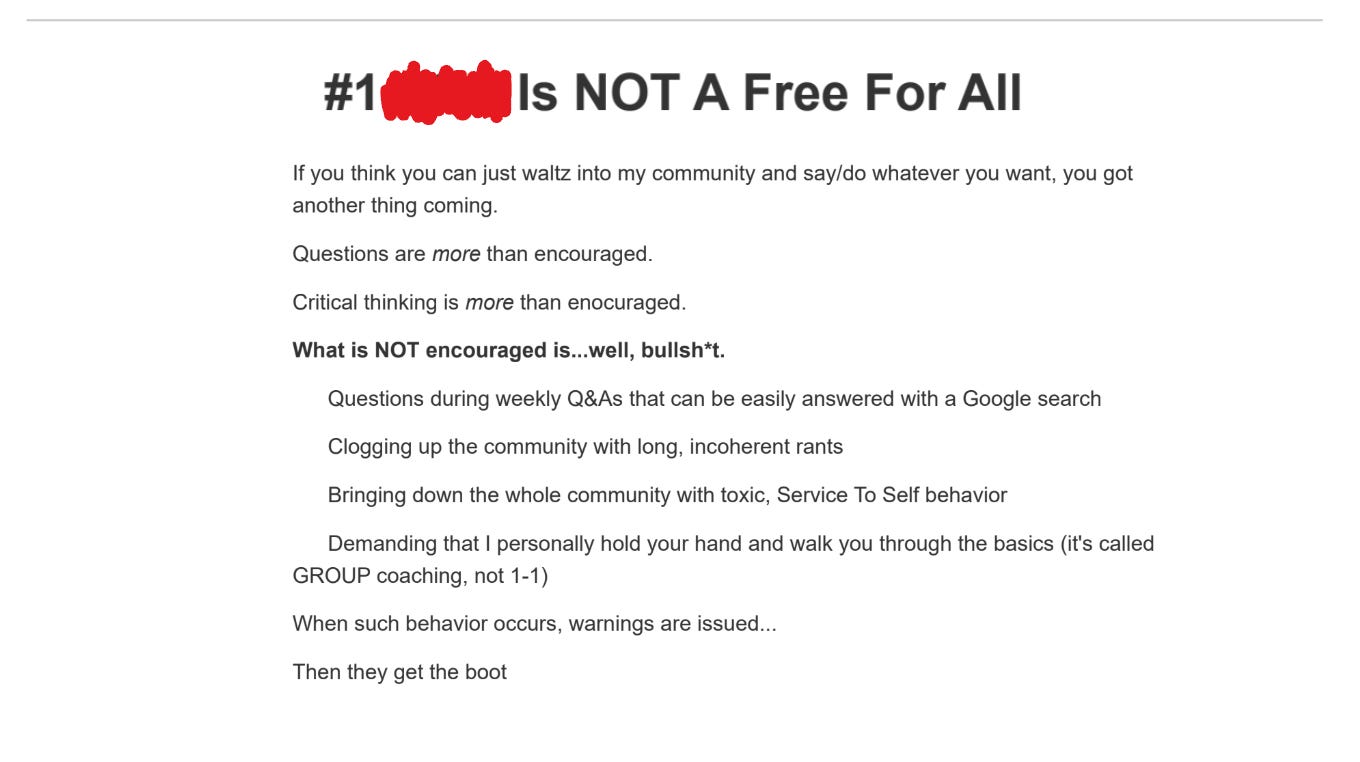
In this section, the language emphasizes:
unilateral authority (“this is MY community”)
behavioral policing (“clogging up the community”)
moralized rule-breaking (“toxic,” “service to self”)
and escalating punishment (“warnings are issued… then they get the boot”)
Sociologist Janja Lalich, who studies bounded-choice systems, notes that high-control groups often present rules as protection while using them to eliminate unpredictability—especially dissent.
The key feature here is not the rules themselves, but the lack of reciprocal accountability. There is no mechanism described for questioning authority, disputing enforcement, or appealing decisions. And when asked about such a mechanism, a loud laugh or a foul remark would be heard.
Rules flow downward. Judgment flows upward.
That asymmetry is the signal.

The False Choice of Exit
“Don’t like it? Don’t join.”
This is the type of language that is often cited as proof of non-coercion. After all, people are free to join or leave.
But cult and coercive-control researchers consistently note that exit rhetoric is not the same as actual freedom.
In Cults Inside Out, Rick Ross explains that high-control systems often emphasize voluntariness precisely when psychological pressure is highest. The threat of exclusion is paired with moral sorting: those who leave simply “weren’t aligned,” “weren’t ready,” or “weren’t strong enough.”
The choice is technically available.
The cost of choosing it is social, moral, and reputational.
That’s not freedom.
That’s leverage.
Sovereignty Language as a Control Mechanism
This section is particularly instructive because it deploys one of the most common rhetorical shields in modern wellness culture: sovereignty.
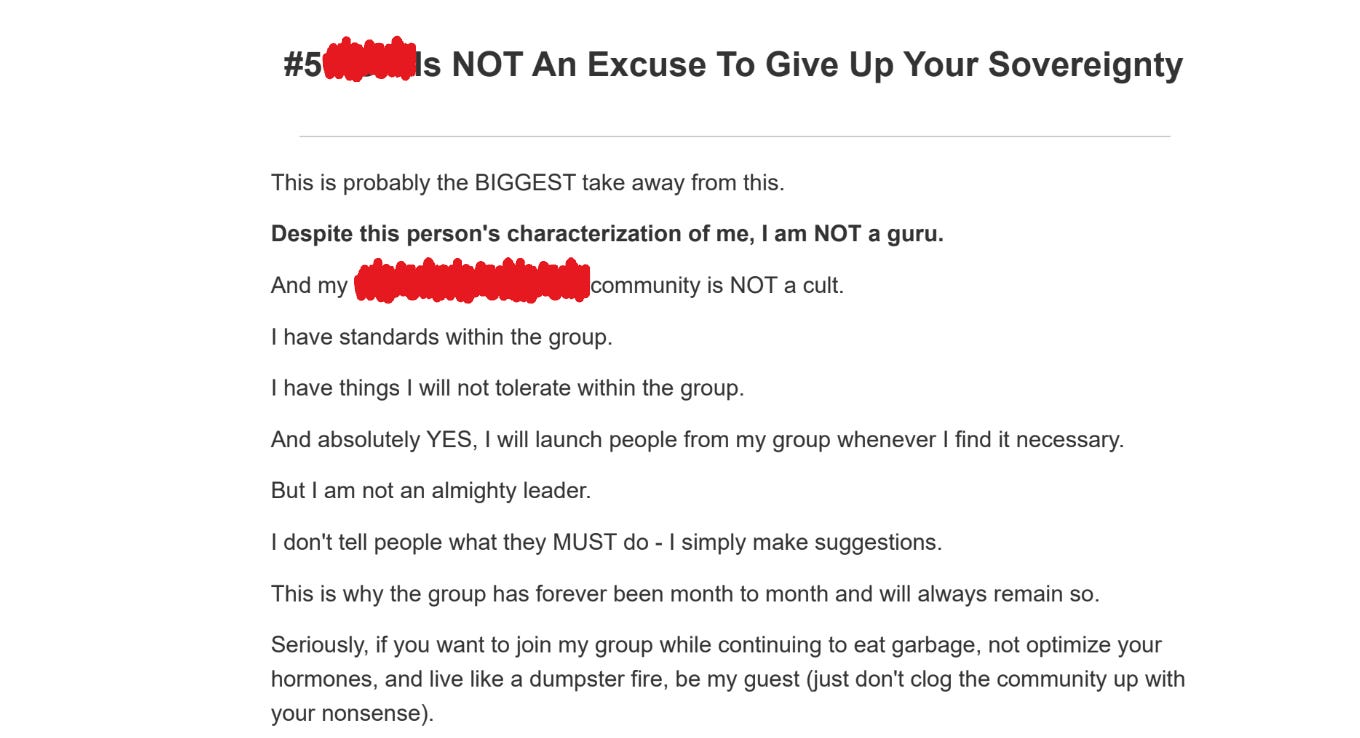
The leader insists:
they are not a guru
they do not tell people what to do
people are responsible for their own outcomes
And in the same breath:
asserts the right to expel members at will
defines what behaviors are acceptable
frames dissent as nonsense
Amanda Montell refers to this as anti-cult branding — the explicit denial of guru status paired with the performance of absolute authority.
The contradiction is not accidental. It allows leaders to benefit from devotion without responsibility.
If people succeed, the system works. If people fail, they misuse their sovereignty.
Loyalty Sorting Disguised as Discernment
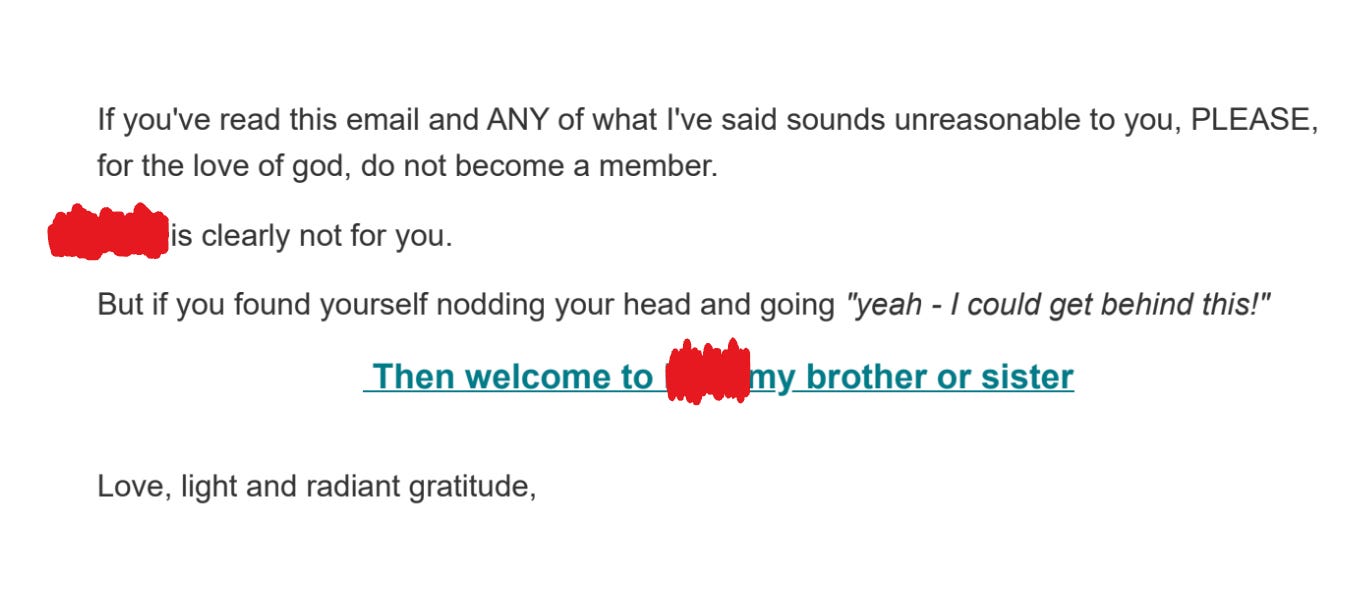
This is the moment the email stops explaining and starts sorting.
Readers are divided into two groups:
those who nod along
and those who should leave
This binary is a hallmark of cultic persuasion, documented repeatedly on both A Little Bit Culty and Cults to Consciousness. It collapses complex reactions into a simple test of belonging.
If you’re uncomfortable, the problem isn’t the content — it’s you.
That framing does something subtle and powerful: it teaches members to distrust their own discomfort. This, this is what this individual does so perfectly.

From Emotional Pressure to Purchase
Finally, the emotional arc resolves into a transaction.
After:
public expulsion
moral sorting
warnings about who does and doesn’t belong
The reader is invited to join. Yep, you too can come in and be apart of this world.
Robert Cialdini, in Influence, describes how heightened emotional states reduce critical thinking and increase compliance. Modern cult researchers point out that this sequence — fear, belonging, offer — is not incidental.
It is a conversion funnel. Ultimately it's about the money, once again!
You are either in…
or you are out.
And the fastest way back in is to pay.
Why This Matters
None of this requires robes, chants, or compounds.
As journalist Jesselyn Cook has reported in her coverage of modern cult dynamics, today’s high-control groups often look like memberships, masterminds, or “communities.” They speak the language of empowerment while quietly narrowing autonomy.
What makes these systems destabilizing is not intensity — it’s how disagreement is handled and how exit is framed.
For me, the most clarifying part of this episode wasn’t what was said about me. It was how quickly authority revealed itself once it felt questioned.
I didn’t set out to make any of this public. That choice was made for me—at scale. And in an odd way, I’m grateful for that. When language like this is broadcast widely, it no longer needs interpretation. It becomes its own evidence.
High-control systems don’t usually unravel because someone exposes them. They unravel when they feel compelled to explain themselves—publicly, emphatically, and with conditions attached.
Sometimes the clearest view of a system isn’t from the outside looking in.
It’s when it steps into the spotlight on its own!
Thank you for reading and sharing my essay.
Let it rip! I am a lone wolf kinda dude. I think I am a tough cult member to recruit. Haha Sorry you have been dealing with this issue.