I have walked around San Francisco for years telling people to pay attention. It is part of how I teach meditation; it is part of how I understand nervous-system regulation, and it has become a huge part of what Sober in San Francisco is about. I want people to experience this city differently, not just go from the hotel to the restaurant to the museum and back again. I want you to notice where you are. I want you to smell the air, walk through a neighborhood, get curious about something you would normally pass, and actually be present enough to remember the experience later.
Well, while I was busy telling everyone else to notice things, I was walking past an entire world of plants I knew almost nothing about.
I mean, I know roses. I know lavender. I can identify a California poppy without assistance. Beyond that, things start getting a little sketchy. I would see these incredible blue flowering shrubs around San Francisco, think, beautiful blue flowering shrub, and keep walking. Recently I started asking what these plants actually were, and that very simple question sent me somewhere I wasn’t expecting. I didn’t just want their names. I wanted to know what they did, how they survived here, whether people had used them medicinally, what happened underneath the soil, and why certain plants seemed perfectly designed for the places where they lived.
That is how I found myself learning about California lilac, or Ceanothus, and how this new series for The Sober Lens began.
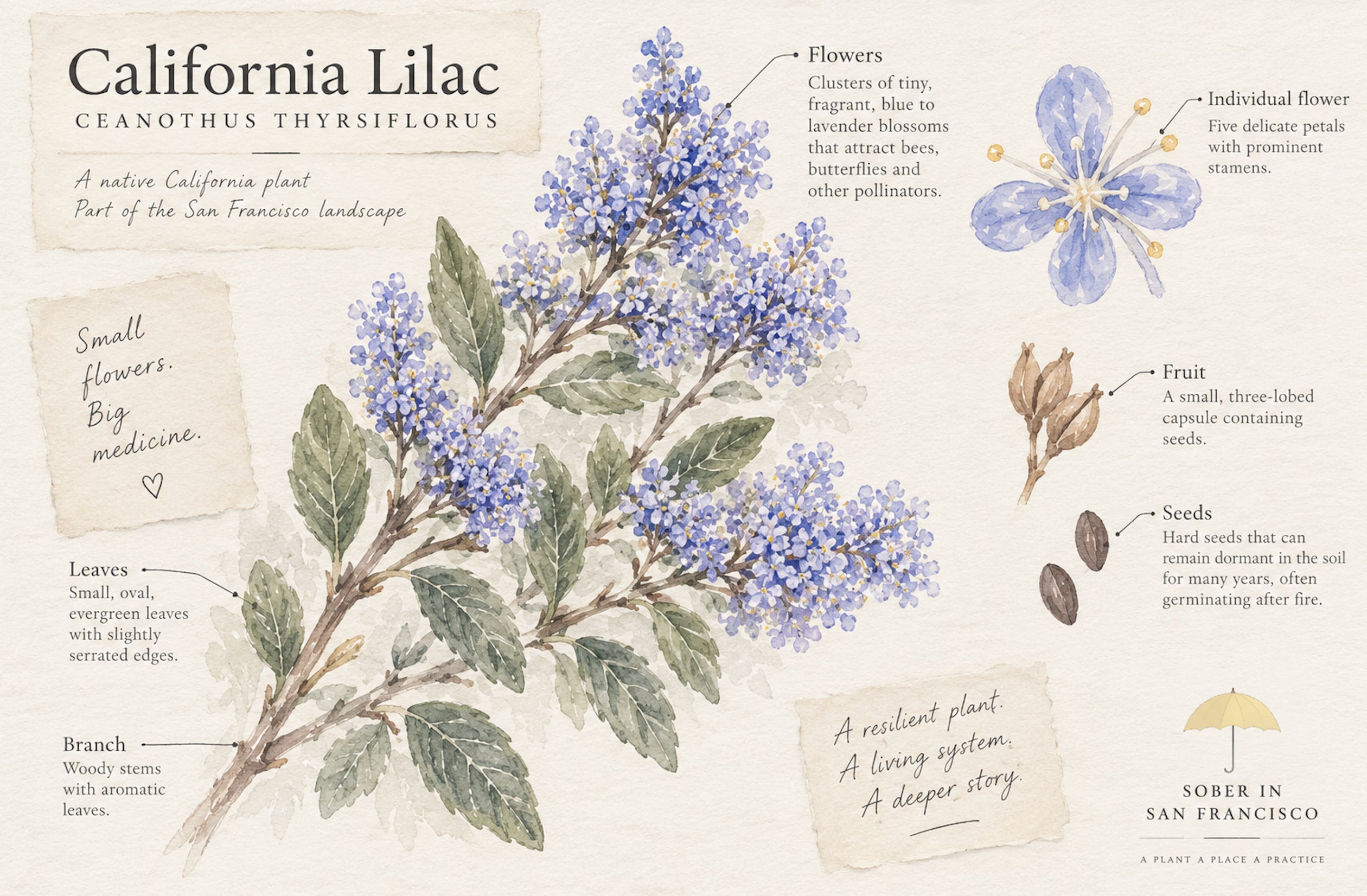
The California lilac
California lilac isn’t actually a lilac. Ceanothus is a genus containing dozens of species, many of them native to California, and the one I am particularly interested in here is Ceanothus thyrsiflorus, commonly called blue blossom or coast blue blossom. It has clusters of tiny flowers that range from pale blue to a much deeper blue, and when it is blooming the number of flowers can make an entire section of the shrub look as though someone painted it.
This isn’t a plant I had to travel somewhere exotic to find. It is part of the landscape here. The National Park Service identifies the Presidio as the type locality for Ceanothus thyrsiflorus, meaning this place is associated with the plant’s original scientific description. It grows in coastal bluff scrub and typically flowers from March into July. Today you can find California lilac in native plantings around the Presidio, including Battery Bluff and Presidio Tunnel Tops.
Once I started researching Ceanothus, however, the flowers became almost the least interesting thing about it.
The Pomo traditionally used the fresh or dried flowers of Ceanothus thyrsiflorus as a soap. When the flowers were mixed with water and rubbed against the skin, they produced a fine lather that was used for washing the hands, face and body. The flowers were also incorporated into ceremonial dance wreaths. Other historical accounts of California Ceanothus species describe the bark and roots being used as an astringent and tonic. Those traditional uses belong to particular Indigenous peoples and particular species, so I don’t want to flatten all Ceanothus into one medicinal plant or pretend that traditional use is an invitation to self-treat with whatever shrub we find in the Presidio. What interests me is what the documented history tells us about our relationship with the plant. This beautiful thing people now put into landscapes as an ornamental shrub was also something people knew intimately and used.
Then there is what Ceanothus does for the land itself. Species in this genus form relationships around their roots with nitrogen-fixing microorganisms, which becomes especially important in depleted landscapes. Research after California fires has documented blue blossom emerging abundantly from dormant seed banks and contributing to the restoration of nitrogen in the recovering ecosystem. In other words, this is not simply a plant capable of surviving difficult conditions. Its presence can participate in repairing the conditions around it.
That was the part that got me.
What is the medicine of a plant?
I have been thinking about the word medicine differently as I work on this project. Medicine doesn’t have to mean swallowing something. A plant can have physical medicine because people have used some part of it therapeutically. It can have ecological medicine because of what it contributes to the environment around it. Then there is the emotional or spiritual medicine we discover by paying attention to how that plant lives.
I don’t want to make that last part up. There is enough wellness language floating around telling us that a particular flower magically represents abundance, feminine energy or whatever else someone decided to put on an Instagram graphic. That isn’t what I’m interested in doing. I want to begin with what we actually know about the plant and see what questions emerge from there.
With California lilac, I keep coming back to cleansing, restoration, belonging and renewal after disruption. The cleansing comes from its real history of use. Restoration comes from its ecological role. Belonging comes from the way this plant participates in its environment rather than simply occupying it. Renewal comes from something I find extraordinary about blue blossom: seeds can remain dormant in the soil, and conditions created by fire can stimulate them to germinate. After the Vision Fire at Point Reyes, the National Park Service documented dormant Ceanothus thyrsiflorus seeds responding to the fire and producing abundant new growth across the burned landscape, which is stunning.
Think about that for a minute. Something can be underground and quiet for a very long time without being gone, waiting for it’s moment. The landscape can change dramatically, and what comes next doesn’t have to look like what was there before.
We, humans, spend a lot of time trying to get back to center, especially with the invent of technology and now AI, that quietly robs our bodies and minds. We try getting back to the body we had, the energy we had, the person we were, the relationship we had with ourselves before something happened. Sometimes getting back isn’t available, and perhaps isn’t even the right goal. Sometimes the more interesting question is what is still alive underneath everything that changed and what conditions might allow it to emerge.
That is the medicine I found in California lilac.
So I’m making a meditation about it
This is where Calm by Lane comes in for you. I am creating a series of Nidra-inspired meditations based on flowers and plants, but each meditation will be built from the actual plant rather than using nature as pretty background scenery.
The California lilac practice is about belonging inside your own body, belonging in the life you have now and finding your way back to yourself after you have lost some sense of who you are. It is also about not waiting for someone else—or some future version of your circumstances—to give you permission to belong.
One idea I keep returning to in the meditation is that something can be dormant without being lost. I think our bodies understand this differently than our thinking minds do. We can spend years believing a part of ourselves has disappeared when perhaps it has simply gone quiet. I don’t want the meditation to tell you what that part is or insist that it needs to return. I hoping to support enough stillness for you to notice what happens when you're offered the possibility.
Then I want you to go find the plant
This is the part that makes the series belong here on The Sober Lens. I don’t only want you to listen to a meditation about California lilac. I want you to encounter California lilac in San Francisco.
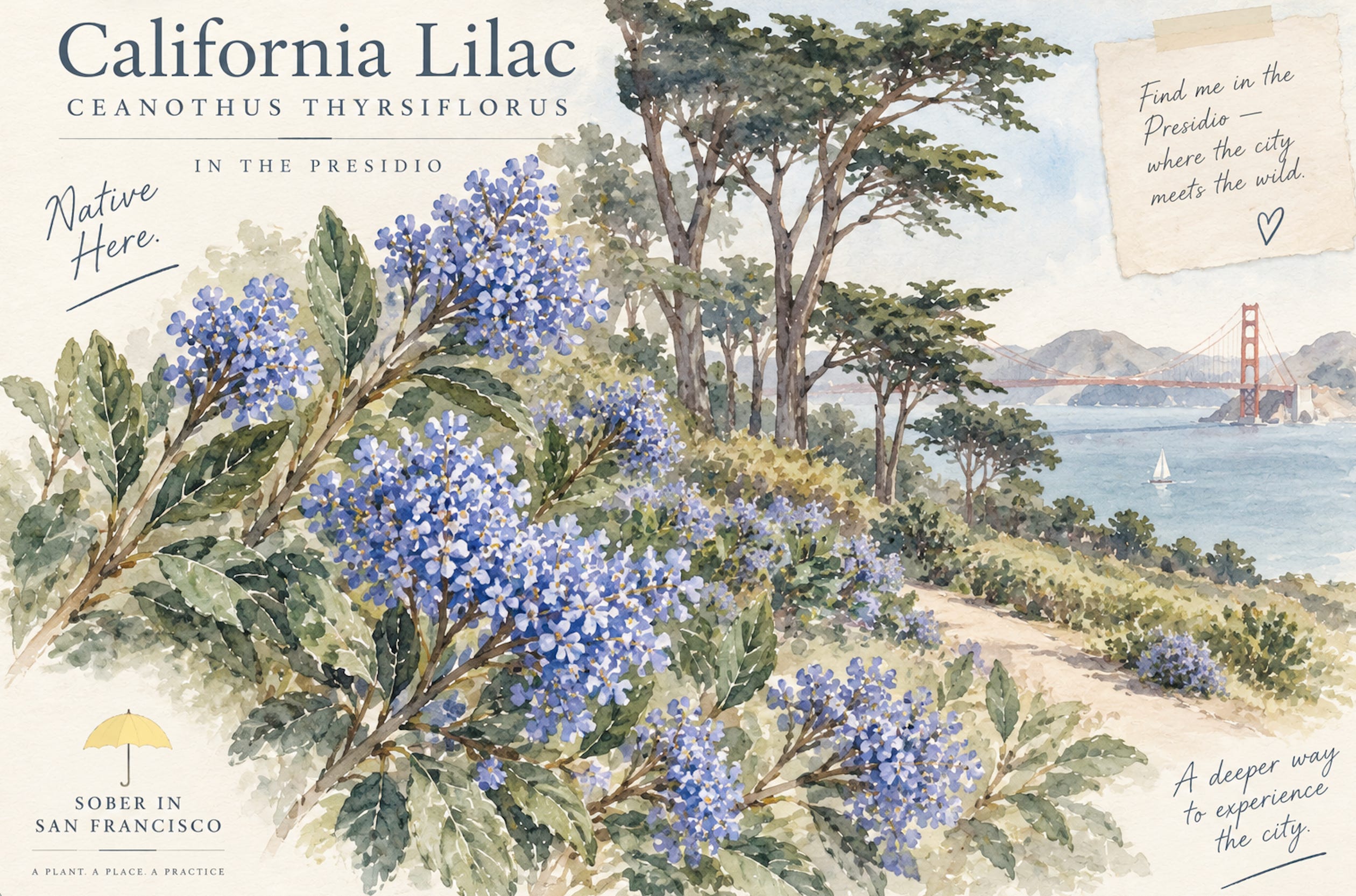
Start by walking in the Presidio. Battery Bluff has extensive native plantings, including my new friend, the California lilac; look for blue blossoms in the larger Presidio landscape. If you catch it during its flowering season, roughly March through July, it is difficult to miss once you know what you’re looking for.
When you find it, get closer. What looks like a wall of blue from a distance is made from masses of very small flowers. Notice the insects around it and the ground underneath it. Think about what is happening below that ground that you cannot see. You don’t need to turn the experience into homework or understand the chemistry of nitrogen fixation. The point is simply to know a little more about what you’re looking at than you did before.
This is increasingly what I want Sober in San Francisco to offer. Yes, I want to tell you where to eat, where to walk, what strange little corner of the city is worth finding and what to do at night when drinking isn’t the center of the plan. But the larger idea has always been intentional living. Sobriety gave me a different relationship with attention, and meditation deepened it. When I am fully present somewhere, the place becomes much bigger than its list of attractions.
So I am going to keep looking. I want to find plants growing throughout San Francisco and understand their physical, ecological, emotional and spiritual medicine. Some will have documented medicinal histories and some won’t. Some may teach us something through the way they recover, protect themselves, cooperate, bloom, go dormant or adapt. If the lesson isn’t actually there, I’m not going to invent one just because I want another meditation.
California lilac is where I’m beginning because the plant gave me more than I expected when I finally learned its name. Its physical history speaks to cleansing, its ecology speaks to restoration, its relationship with this landscape speaks to belonging, and its response to disruption gives us a remarkable way to think about what it means to begin again.
It turns out I had been walking past the first meditation for years.
Listen Now.
Grab the Three-Day Guide For Your Time in San Francisco.