

Last week, one of my DNA clients, Sarah, arrived at our session looking like someone whose nervous system had been holding its breath for years, this week she was fried. There is a particular kind of exhaustion common among high-functioning professionals — not collapse, not burnout in the dramatic sense, but a taut, humming depletion, I see it everywhere! Dark circles that no amount of sleep seems to erase. A jaw set so firmly it appears architectural. The outward competence remains perfectly intact while the body quietly signals distress.
“I just need better boundaries,” she announced to the class. “Or maybe I just need better systems.”
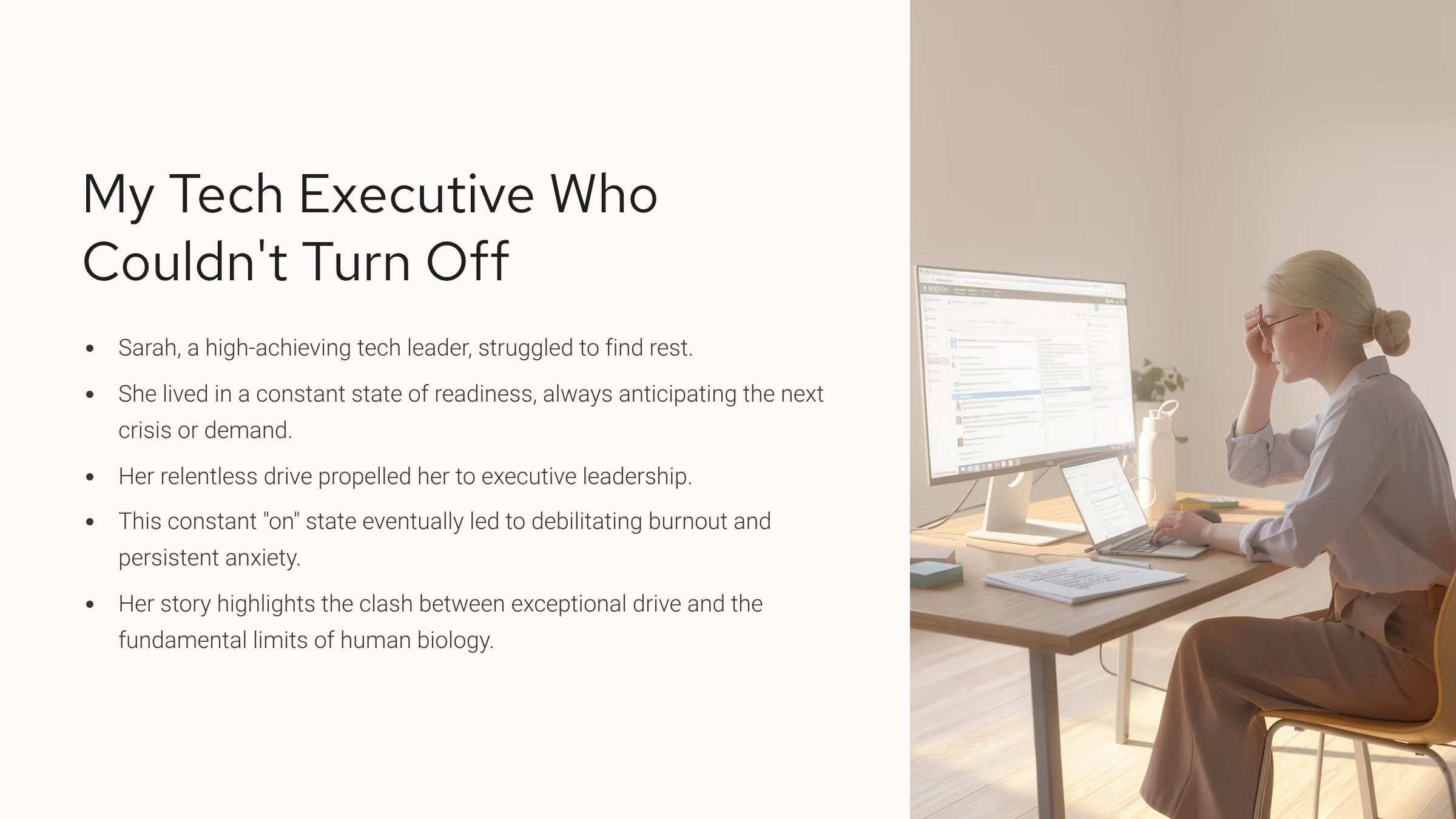
These are familiar explanations and they seem to be comforting. Systems can be redesigned. Boundaries can be fortified. But what Sarah was describing — the relentless mental activity, the inability to downshift, the sense that her mind never fully powered down — did not behave like a scheduling problem. It behaved like physiology.
She had done what conscientious, intelligent people do. Therapy. Exercise. Meditation apps. Digital detox weekends were attempted with near-religious sincerity. Yet, none of it produced the relief she expected. The advice was sound. The effort was real. Yet the internal noise persisted, as though some unseen mechanism refused to disengage.

The COMT gene rarely enters casual conversation, though its effects are often hiding in plain sight. COMT — catechol-O-methyltransferase — governs an enzyme responsible for clearing key neurotransmitters, including dopamine and norepinephrine, from the prefrontal cortex. In less technical language, it influences how efficiently the brain regulates the chemistry associated with focus, arousal, and stress response. I link it to how one manages their stress.
Sarah, carried the Met/Met variant, a configuration associated with slower enzymatic activity. This variant is neither a defect nor a diagnosis; it is simply a difference in processing speed. Under stable conditions, individuals with this profile frequently display excellent cognitive performance. Working memory can be strong, attention precise, thinking both quick and nuanced. The difficulty emerges under sustained pressure, when stress chemistry accumulates faster than it clears.
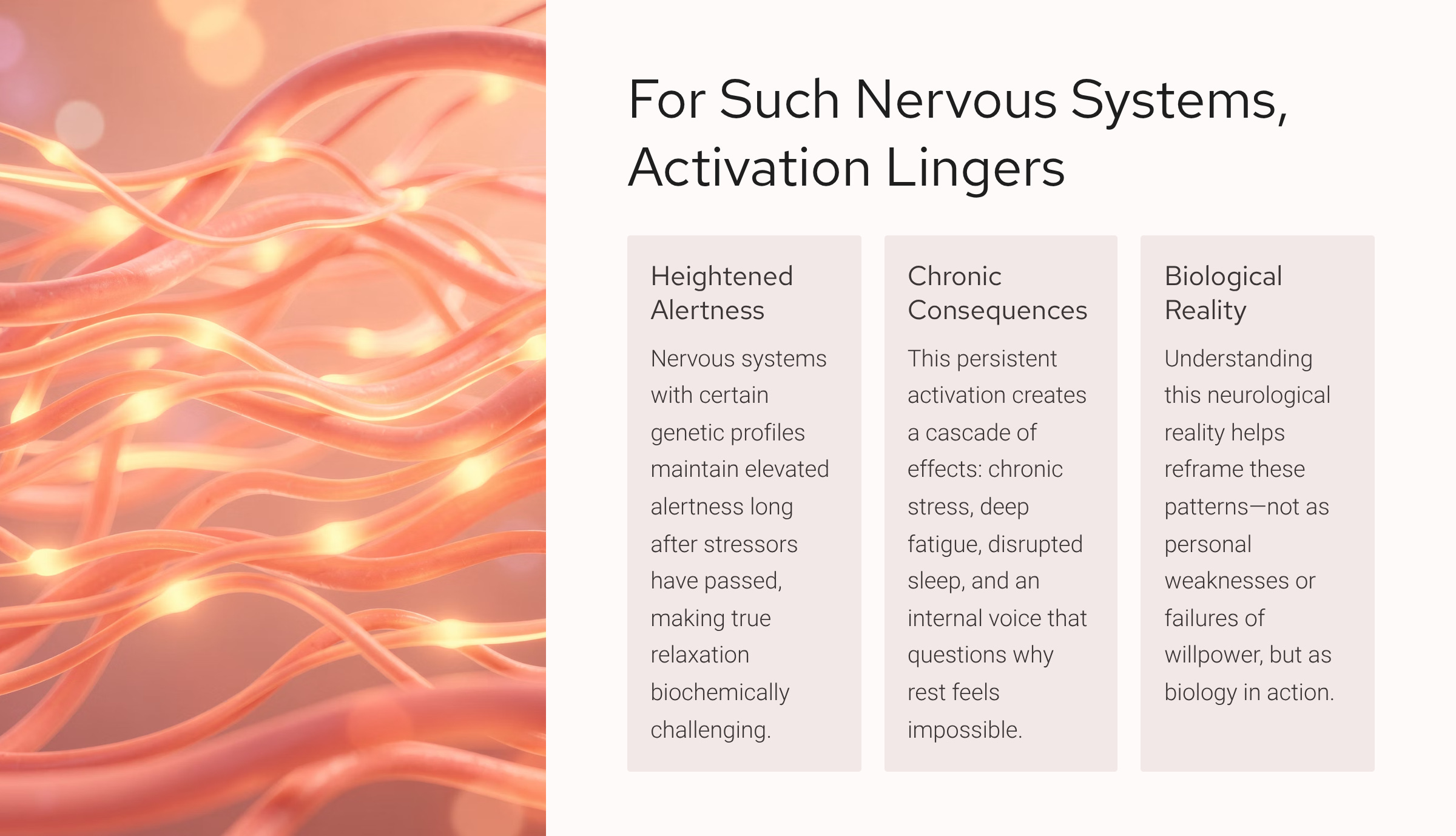
The modern language of stress management often implies that downregulation is a skill gap. Breathe more deeply. Practice mindfulness. Establish firmer boundaries. These interventions are undoubtedly useful, yet they tend to assume a nervous system that resets itself on a relatively predictable schedule. Sarah’s did not. Her system, by design, held onto arousal signals longer. The issue was not ignorance of calming strategies but the biological tempo at which her brain metabolized stimulation.
“Just relax” is easy advice to give. It is considerably less useful when the underlying chemistry resists quick resolution.
Research over the past two decades has repeatedly shown that variations in catecholamine regulation influence how individuals experience and recover from stress. When neurotransmitters associated with alertness and executive function persist at elevated levels, cognitive quiet becomes difficult to access. The mind continues scanning, modeling, rehearsing. Thoughts do not slow merely because circumstances do. Many people interpret this as overthinking or poor emotional discipline. In reality, the nervous system may be operating exactly as configured.

Sarah had come to believe that her difficulty disengaging reflected a failure of personal management. After all, others seemed capable of finishing a workday and mentally shifting gears. Why not her? The prevailing cultural narrative offers few alternatives. Stress is framed as an input problem — too many demands, insufficient boundaries — rather than an interaction between environment and biology.
Genetics, inconveniently, complicates that story.
Some nervous systems clear activation quickly, like efficient custodians tidying the biochemical workspace. Others process more slowly, allowing signals to echo. Neither is inherently superior. Each carries trade-offs. But expecting identical responses from different neurobiological architectures is akin to expecting identical performance from engines built with different tolerances.
What ultimately helped Sarah was not revelation but repetition.
She committed to daily regulation practices, not as aspirational self-care but as maintenance for a system prone to prolonged activation. The work was strikingly unglamorous: rhythmic breathing, somatic downshifting, predictable routines, and a deliberate reduction of unnecessary cognitive load. Rather than attempting to think her way into calm, she learned to influence state through the body — movement, sensory modulation, and paced transitions between tasks.
Consistency proved decisive.
Nervous systems characterized by slower clearance do not respond reliably to sporadic interventions. Stress chemistry accumulates incrementally, and regulation must be equally regular. Over time, the body relearns a wider range of states. The dimmer switch, once perceived as stubbornly fixed, reveals some flexibility. Neural plasticity is real, though rarely hurried.
There is an irony embedded in modern high-performance culture. The individuals most committed to improvement are often those most inclined to blame themselves when standard solutions fail. The assumption persists that sufficient discipline should overcome internal friction. Yet biology is not particularly moved by determination alone.
Understanding mechanism does not eliminate responsibility, but it refines it.
Sarah did not require stronger willpower. She required a strategy aligned with her nervous system’s operating characteristics. The shift from self-correction to self-comprehension altered everything. What had felt like a mysterious personal deficiency became an intelligible pattern. With that understanding came relief of a different kind — not immediate tranquility, but the absence of misplaced shame.

My Irish Wolfhound, Magnus, offers a surprisingly simple lesson in regulation. When he wants to go outside, he does not negotiate or strategize. He stands directly in front of me, vast and immovable, until the desired outcome occurs. No rumination. No productivity guilt. No existential narrative. Simply a steady signal delivered with patient certainty.
The nervous system, I have come to suspect, operates with similar indifference to our stories. It responds to rhythm, repetition, and environmental cues far more than to intellectual argument. We imagine regulation as a matter of mindset when it is, to a remarkable extent, a matter of biology meeting behavior.
The more interesting question is not why some people cannot “just relax,” but why we remain surprised that different systems require different forms of care.
Once you see the mechanism, the mystery dissolves.
And in the space where self-blame once lived, something quieter — and far more useful — can finally take hold.