

I didn’t leave a wellness space because I stopped caring about my health.
I left for several reasons, and one of them was that I started noticing what happened to people who disagreed.
When you’re inside one of these ecosystems, it’s subtle. You tell yourself the rules are about “safety,” “standards,” or “keeping things productive.” And remember, I was running one of these high-profile wellness spaces. I was privileged to be in a (LOUD) text conversation where I was always being told to eliminate people. I listened to the leaders' backstories—and how to kick people out for their noncompliance and agitation toward him. But what's become very clear is that once you step out—and your nervous system stops checking—you begin to see the craziness of the wellness influencer.
A new class of wellness authorities is rising. They’re polished. Credentialed. Calm-voiced. They talk about health optimization, balance, doing it the right way, spiritual alignment, and all the subtleties are there. But I’m beginning to see a trend: they shut down opposing opinions not by engaging the data or having a discussion, but by disciplining the person and silencing them.
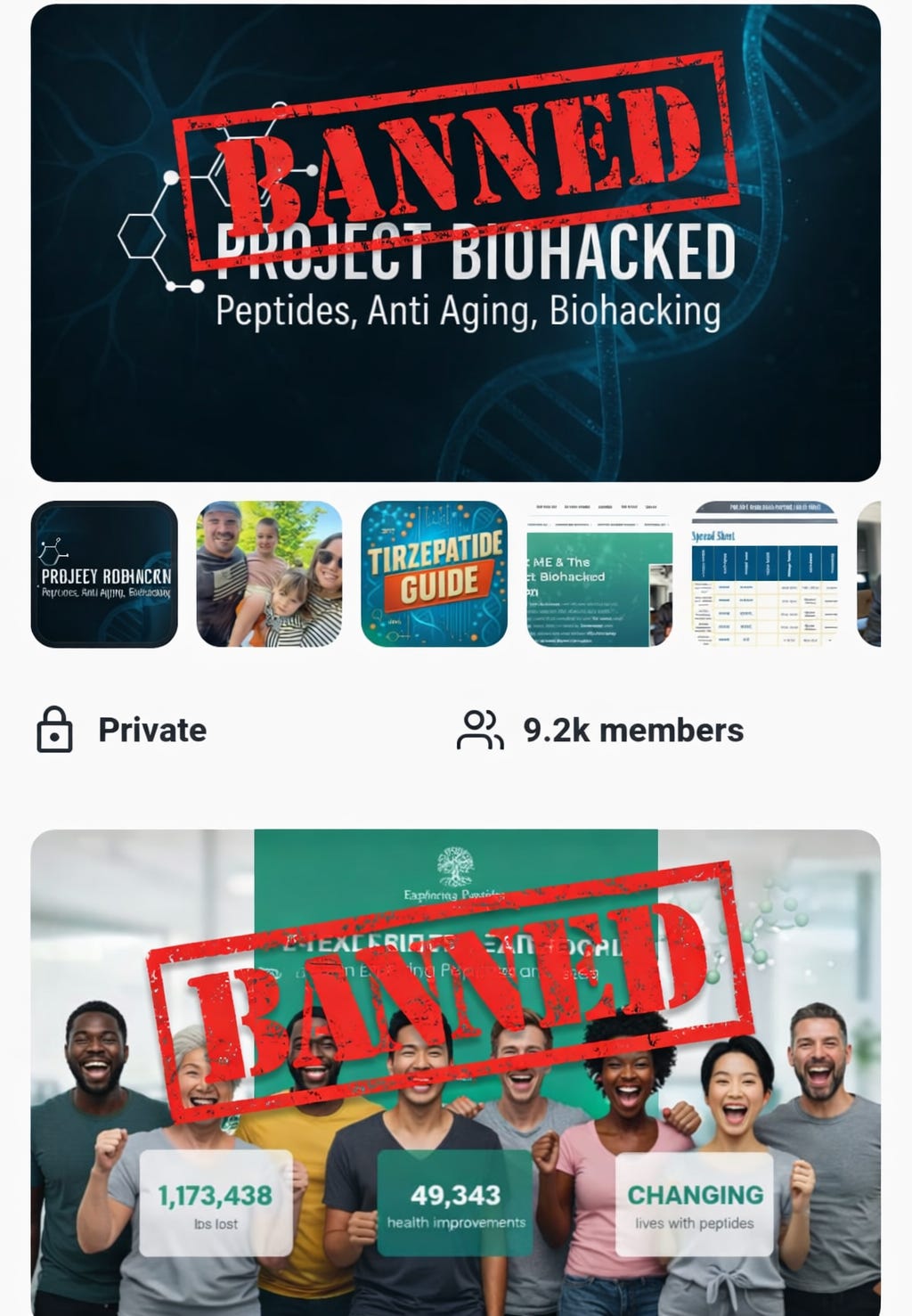
Recently, a friend of mine has been banned from multiple online wellness groups. Once upon a time, he was also removed from the group I ran; the leader asked me to remove him, saying his content was triggering. The fact was, my friend, put up a no-nonsense post about his CAC scan and also added Ben Greenfield's Video on said topic. Perhaps it was a contrarian point of view, or perhaps my friend is just super smart, yet the leader couldn't say, Oh, I don't know much about that, why don't you tell me about it. He was simply removed. He wasn't kicked out for spreading false information. He was kicked out for presenting other data that challenged a health influencer’s conclusion.
If you’ve read my earlier work, you know I’ve written about what it’s like to be abruptly abandoned by a health community I once trusted. I named a dynamic I saw. The response wasn’t dialogue.

It was retaliation, followed by a very public reframing of me as the problem.
I don’t revisit that story here to relitigate it. I revisit it because once you’ve lived through social exile in a wellness space, you start recognizing the pattern everywhere.
Oposing or Different Gets Reframed as “The Problem”
Here’s the move I see most often now.
Someone raises a legitimate question. Maybe it’s about biomarkers. Maybe it’s about methodology. Maybe it’s about whether a claim is being overstated. Or maybe it's simply a different result. Instead of leaning into curiosity and dialogue, the authority figure pivots and subtly suggests the person raising the question is the issue!
Suddenly, it’s not about the opposing comment or idea—it’s about how the comment was made and how the person asking is being difficult.
Below, you will see the exact words from an influencer here on Substack who writes about making metabolic health mainstream. He has a rather large following, and from what I have read, he acts cute when comments are in favor of his writing, but behind the direct message wall comes something like this:
“I'm putting you on notice that the way you are going about it reveals a failure of emotional regulation, and it's inappropriate. You can — if you so choose — course correct.
Take a moment to think before you respond, then do so carefully.”
Who talks like this to paying subscribers? Who chooses this tone when a respectful question is being asked?
Yes—this person is highly educated. A researcher. A Harvard PhD. Undeniably smart. But intelligence and credentials don’t grant permission to speak down to people, nor do they turn an influencer into an unquestionable authority. Expertise should invite clearer thinking, questions, curiosity, not compliance.
This isn’t the language of inquiry. It’s the language of hierarchy. And the implication remains the same: the issue isn’t the content of the question, it’s the character of the person asking it. That move doesn’t strengthen science—it shuts it down.
Being brilliant doesn’t require being dismissive. And being credentialed doesn’t make someone the final arbiter of truth.
So what ends up happening? People adapt. They soften their language. They ask fewer questions. They keep their doubts to themselves. Not because they’re convinced—but because they’ve seen what happens when someone isn’t compliant.
That’s not discourse. That’s enforcement.
Why Confident Narratives Crowd Out Complexity
Part of why this works is deeply human. We are drawn to certainty—especially in systems as confusing and personal as health. Our health world is so complex, and we are all feeling it, so when someone rises up and takes a stand, we find ourselves paying attention.
“What you see is all there is,” Daniel Kahneman wrote—and that’s exactly how confident narratives gain power. When explanations are delivered with certainty, the brain stops scanning for gaps. Complexity gets flattened. Clean stories feel safe, even when they’re incomplete!
In wellness culture, this often means a single metric, protocol, or framework is elevated as the answer. Contradictory data isn’t explored—it’s treated as destabilizing. Questioning becomes a threat not because it’s wrong, but because it introduces uncertainty. And uncertainty is bad for authority.
What This Does to the Body
Here’s what gets lost in the language of “regulation” and “safety.”
Social punishment—being shamed, silenced, or removed from a group—registers in the nervous system as threat. Research led by UCLA neuroscientist Matthew Lieberman shows that social rejection activates the same brain regions involved in physical pain.
So when people are publicly corrected, privately warned, or quietly banned for dissent, their bodies respond accordingly. Fight. Flight. Freeze. Fawn.
Most choose fawn. My body chose for me in full flight and froze!

They comply. They self-censor. They stay agreeable. And the community calls this emotional maturity.
A genuinely regulated system can tolerate friction. It doesn’t confuse challenge with danger.
What I Look for Now
I don’t ask anymore whether a wellness leader is thoughtful, articulate, or “evidence-based.”
I think about these questions:
What happens when someone disagrees with them?
Do they engage in thoughtful, considerate conversation, or do they manage the person?
Do they welcome correction—or redirect to tone, professionalism, or emotional state?
Because banning people for opposing views doesn’t protect health. It protects hierarchy.
The healthiest environments I’ve ever been part of—scientifically and psychologically—shared one trait: leaders who could say, without defensiveness,
“I might be wrong.”
“That’s worth looking at.”
“Let’s stay curious.”
No warnings. No moral theater. No quiet punishments.
Just inquiry.
The Clarity That Comes After Exile
When I stepped away from these spaces, I didn’t feel lost. I felt clearer. Calmer. More grounded in my own thinking.
That, too, is data.
If a wellness community makes you anxious about speaking, careful with your words, or unsure whether your questions are welcome, listen to that signal. Your body often recognizes coercion before your mind has language for it.
Health doesn’t require loyalty.
Science doesn’t require obedience.
And no one gets to own your biology.
If a system can’t survive honest disagreement, it isn’t fragile because the science is complex. It’s fragile because the authority is.
Thank you for reading and being a part of my regulated journey!
Check out more of my work here.
Great article, and so spot on with what I see nowadays. Funny enough, my wife was just saying something similar to me from what she was seeing on Facebook. I am seeing more and more that social media is becoming just an echo chamber where only similar opinions can be shared. Everything is made to be black or white, when as you know there is so much nuance to all this stuff. If you aren't “with us” you are against us. There are a lot of fragile egos out there, and you see this across the spectrum, from the more “woo woo” biohackers to the “evidence based” gurus.
Well said. And I hope I keep getting banned. lol. The way Iook at it isn't to stay silenced or course-correct whatever the guru said I was doing wrong it's instead to speak freely in my own forum. Even if that means speaking to a much smaller audience. The freedom of being one's own boss of one's speech is where the liberation comes. And it attracts like-minds. I've always been a speak-and-let-speak kind of guy. It stems from my First Amendment political activism days. In the broader sense I don't understand "cancel culture". Someone doesn't like another's speech so they want the person silenced? I cannot fathom such an idea. It'd be death of freedom. If I don't like another's speech I don't pay attention to it. It doesn't occur to me to seek censorship of it! In the wellness space maybe I say something and I'm completely wrong. I have no issue with that. But it seems that gurus do!