

Welcome to Unregulated to Regulated — my small corner of the internet where I write about rebuilding the nervous system, stress management, invisible illness, recovery, and learning how to live slowly in a culture addicted to speed.
Short Synopsis
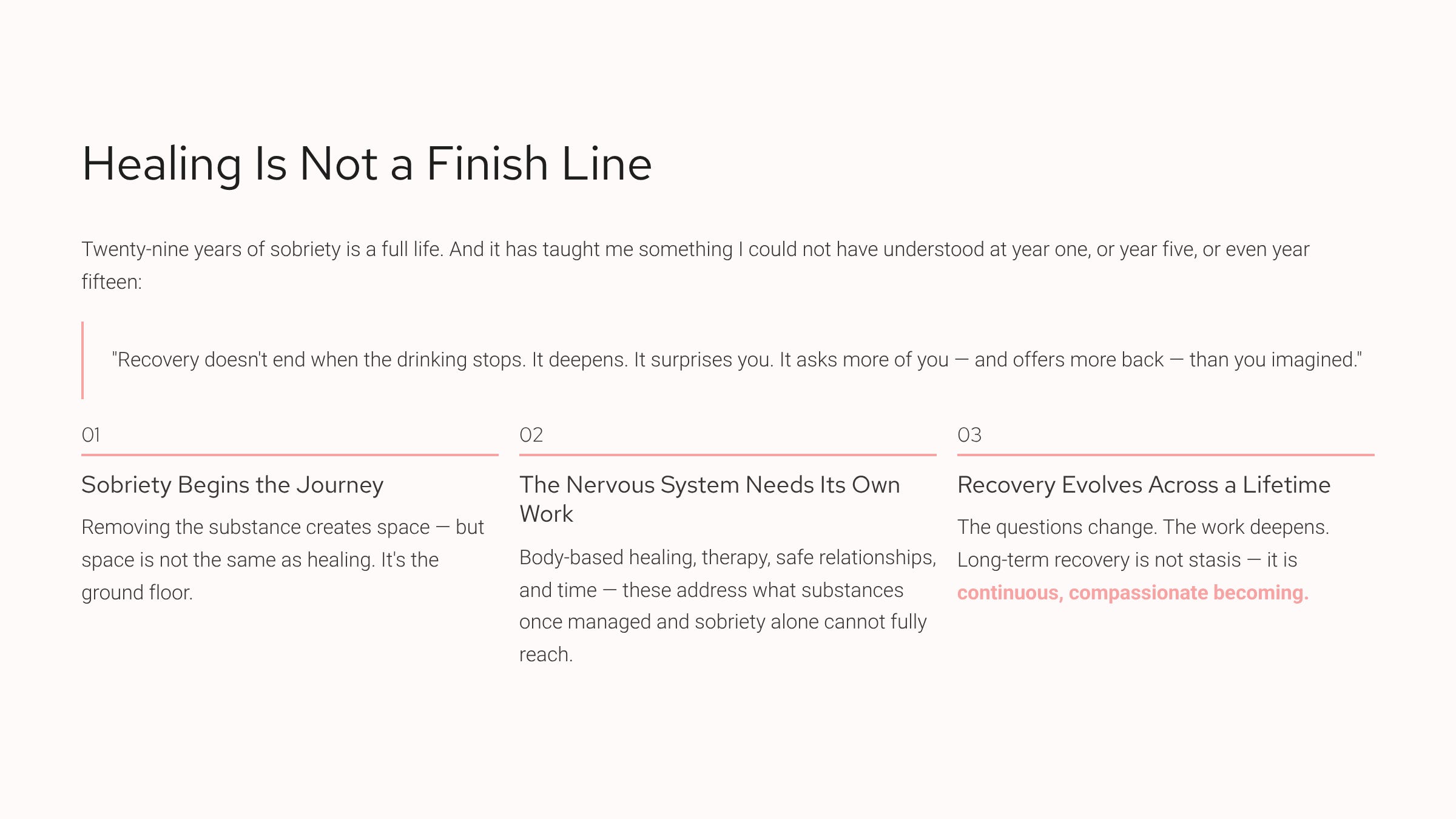
I’ve been sober for 29 years, that's a full life! For a long time, I thought recovery meant I had arrived somewhere stable. What I understand now is that sobriety was just the beginning. This piece explores how recovery evolves, how the nervous system carries what sobriety alone doesn’t resolve, and why healing is not a finish line.
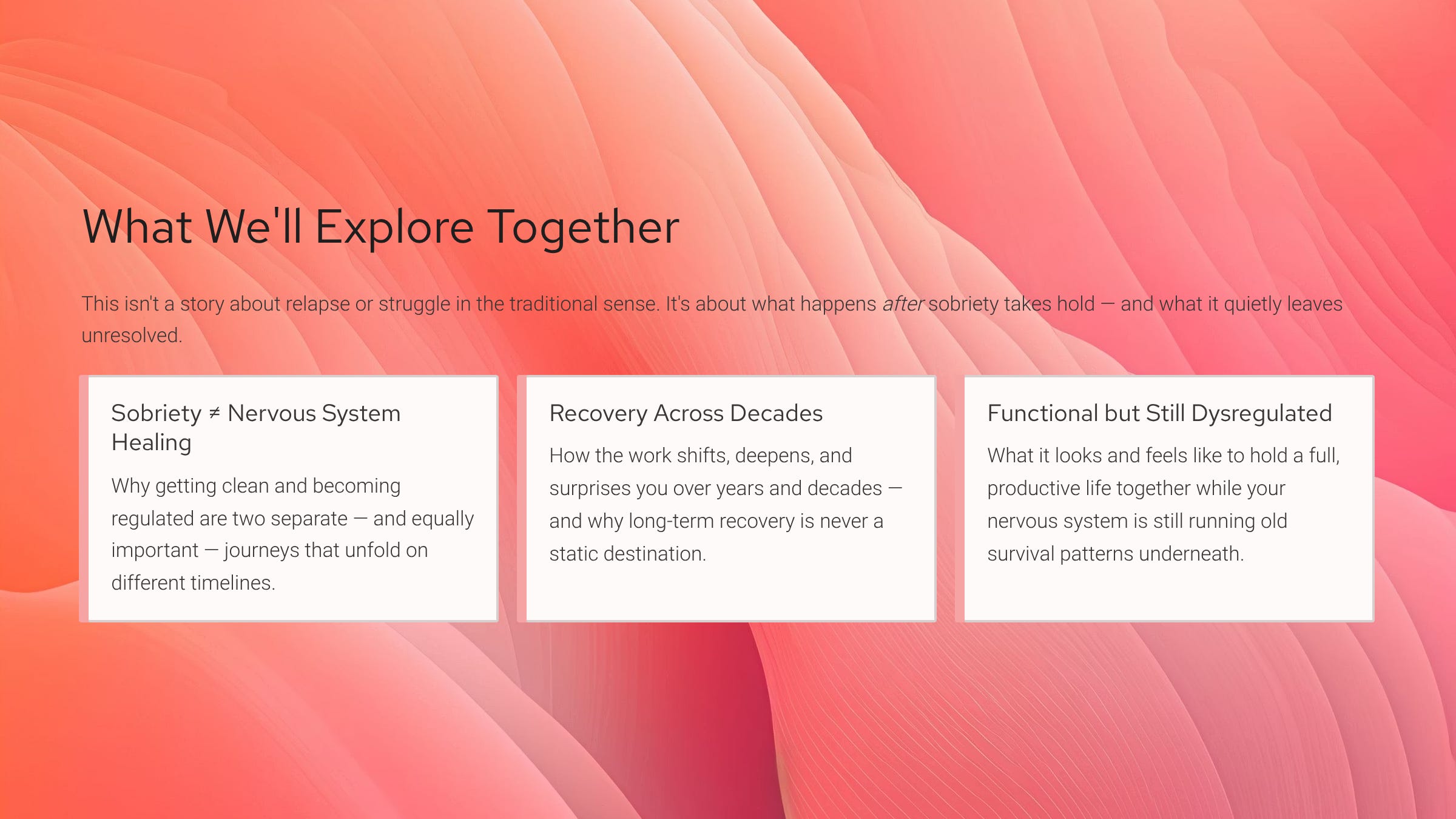
What We’ll Explore
Why sobriety and nervous system healing are not the same thing
How recovery evolves over decades, not just years
What it means to be “functional” but still dysregulated
I got sober when I was youngish.
Young enough that I built an entire life on the other side of it. A career, relationships, a sense of purpose, a rhythm that made sense. Sobriety gave me structure. It gave me clarity. It gave me access to a life that, at one point, I wasn’t sure I would have.
And for a long time, I believed something very simple.
That if I stayed sober, I would be okay.
Not perfect, not immune to life, but fundamentally okay. Stable. Grounded. Past the hardest part.
In many ways, that belief carried me.
Sobriety teaches you that you can rebuild. That you can become someone else. That discipline, honesty, and service can reshape your life in ways that feel almost impossible when you’re in it.
And it did.
But here’s what I didn’t understand then.
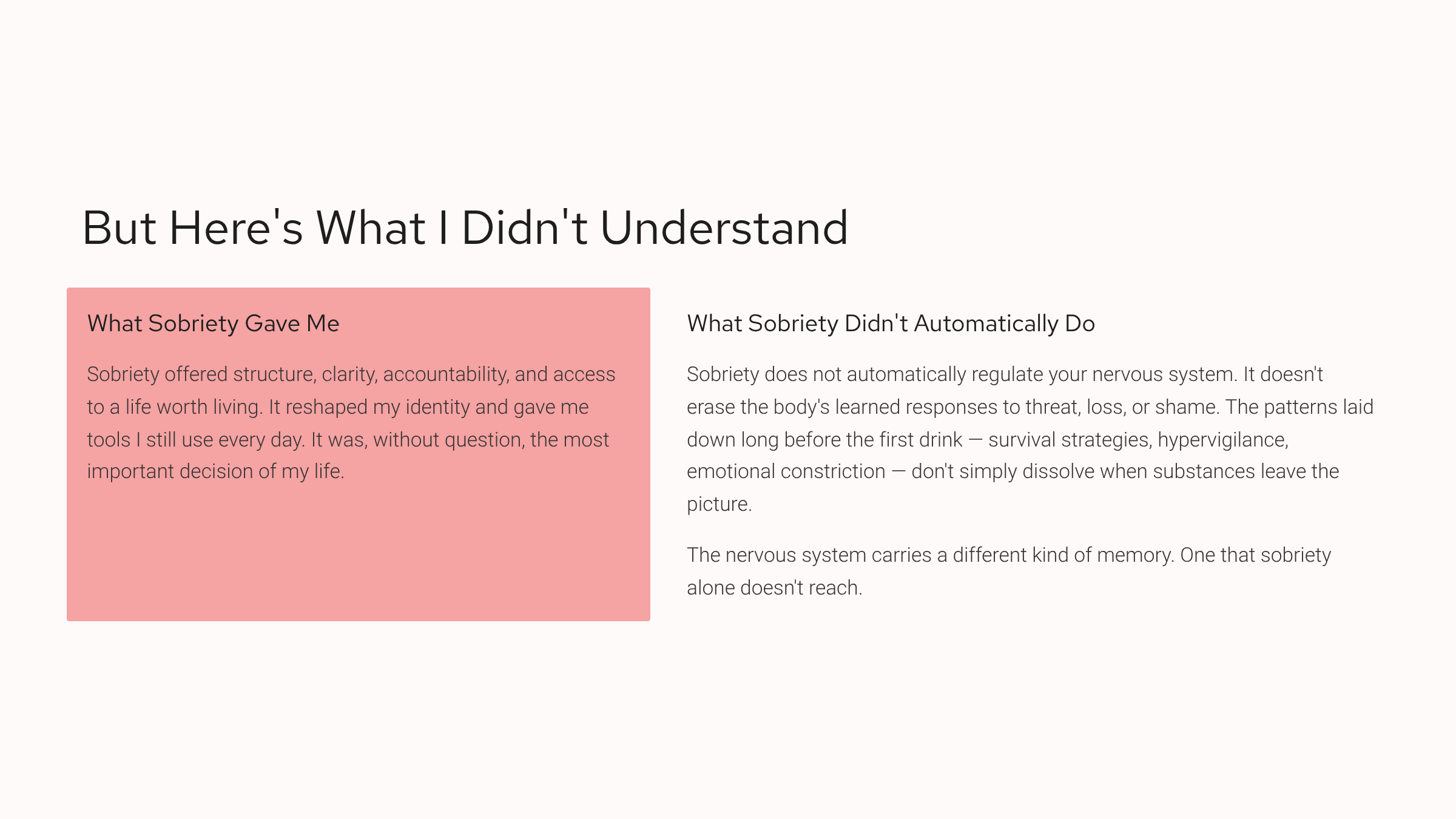
Sobriety doesn’t automatically regulate your nervous system.
The Part No One Explains
When you remove alcohol or drugs, you remove the most obvious coping mechanism.
You stop numbing. You stop escaping. You stop artificially shifting your state.
That is powerful.
But underneath that, the body still exists.
The nervous system still carries patterns. Old stress responses. Old wiring. Old adaptations that were built long before you ever picked up a drink.
And those don’t just disappear because you stopped using.
They wait.
Sometimes quietly. Sometimes subtly. Sometimes for years.
Functional Is Not the Same as Regulated
For decades, I was what most people would call high functioning.
I worked. I built. I showed up. I helped others. I was disciplined, consistent, and, by most external measures, doing very well. And I was.
But I was also living with a nervous system that was still running a certain kind of program.
A program of urgency. Of pushing. Of overriding subtle signals in my body because I had learned, over time, that forward movement was the goal.
That being productive, useful, and available meant I was doing life correctly.
It didn’t look like addiction anymore.
It looked like success.
Recovery Evolves, Whether You Want It To or Not
There’s a moment—if you stay on this path long enough—where recovery asks something different of you.
It’s no longer about not drinking.
It’s about how you are living.
How you are relating to your body. Your energy. Your capacity. Your limits.
It’s about whether you can feel what’s happening inside you without needing to fix it immediately.
And that’s where things can get uncomfortable again.
Because the same intensity that once drove addiction can quietly reshape itself into something else.
Work. Control. Perfection. Speed.
My Nervous System Eventually Said No
About a year ago, my body made something very clear to me.
The way I had been living—even sober, even disciplined, even “healthy” by many standards—was no longer sustainable.
Dysautonomia has a way of interrupting whatever narrative you’ve been relying on. It doesn’t ask for your opinion. It doesn’t negotiate with your schedule.
It changes the rules.
Dysautonomia, Explained: My Nervous System Reacts to Things That “Shouldn’t Matter”

When I tell people I have dysautonomia, they usually blink at me and turn their head sideways, saying…
And suddenly, all the things I could once push through became things I had to listen to.
Fatigue wasn’t something to override.
It was something to respect.
And that shift has been one of the most humbling parts of my life.
Sobriety Was the Beginning, Not the End
I don’t say any of this to diminish sobriety.
Sobriety saved my life.
It gave me the foundation for everything that came after.
But what I understand now is that recovery is not a single decision you make once.
It is a relationship you build over time.
And that relationship deepens.
It asks more of you.
It asks you to look at the parts of yourself that are still gripping, still pushing, still trying to control outcomes in ways that your body can no longer sustain.
A Different Kind of Recovery
These days, recovery looks quieter for me.
It looks like paying attention to how my nervous system is actually responding, not how I think it should be responding.
It looks like allowing rest without turning it into failure.
It looks like noticing when I am reaching for something—anything—to change how I feel, and asking myself what is underneath that impulse.
Because that impulse is still there.
It just wears different clothes now.
What I Wish More People Understood
If you are someone who has been sober for a long time and you still find yourself struggling in ways you can’t quite explain, I want to offer you something that took me a long time to see.
It doesn’t mean you are doing recovery wrong.
It may simply mean there is another layer.
A layer that has nothing to do with willpower or discipline.
A layer that lives in the nervous system.
And that layer deserves attention too.
So here’s the question I’ve been sitting with lately:
If sobriety removed what you used to escape… what have you been living with underneath it all this time?
Thanks for being here and slowing down with me for a few minutes.
In a world that keeps accelerating, learning how to regulate our nervous systems may be one of the most important skills we develop.
If you’re practicing that too — you’re in the right place.