


Welcome to Unregulated to Regulated — my small corner of the internet where I write about rebuilding the nervous system, stress management, invisible illness, recovery, and learning how to live slowly in a culture addicted to speed.
Here Are Some Reader Favorites To Enjoy
Dysautonomia, Explained: My Nervous System Reacts to Things That Shouldn't Matter
When Someone You Love Shuts Down
About a month ago, I met John Brewton :)
If you spend time on Substack, you may already know his writing. John isn’t a fly-by-night voice. He’s thoughtful. Measured. He writes like someone who understands that ideas have consequences. I’m one of his founder subscribers, and when he publishes something, I tend to stop what I’m doing and read it.

That pause matters.
Because most of the internet does not reward pause.
Most of it rewards speed.
John writes with a backbone, and I appreciate that. He’s not simply producing content. He’s trying to help people think. He's inviting people to play differently.
Recently, he wrote a note that struck me. In it, he reflected on the difference between speed and thoughtfulness in our current culture. The internet moves quickly, he pointed out, but speed is not the same thing as depth. Real thinking takes time. It requires space—mental and emotional space—to wrestle with ideas rather than react to them.
That observation might sound obvious, but in practice it’s increasingly rare.
We are living inside systems designed to keep us reacting.
And our nervous systems are paying the price.
The Nervous System Was Not Built for the Internet
I feel like I need to have those words written on a billboard.
There is a biological reason thoughtful writing feels different from reactive content.
The human brain operates through two broad cognitive modes. Psychologist Daniel Kahneman famously described them as System 1 and System 2 thinking.
System 1 is fast, emotional, and reactive. It scans for threats and makes rapid decisions.
System 2 is slower, analytical, and reflective. It requires time and cognitive energy.
Modern digital platforms overwhelmingly stimulate System 1.
Notifications. Alerts. Breaking news. Social media feeds that update every few seconds. The brain is constantly scanning for novelty, which triggers the amygdala—the region responsible for threat detection. This keeps the sympathetic nervous system active, releasing small pulses of adrenaline and cortisol throughout the day. This is why we ache; this is why, when you land on your couch at night, you want to check out to another episode of Jon Hamm, in Friends & Neighbors… which is coming out on April 3, 2026!
We think we are just “scrolling.”
But biologically, we are staying in a low-grade stress state.
Over time that stress accumulates. Neuroscientist Bruce McEwen described this phenomenon as allostatic load—the wear and tear on the body when stress responses are activated too frequently without adequate recovery.
When allostatic load rises, exhaustion follows.
Not sleepy exhaustion.
Nervous system exhaustion.
Why Thoughtful Writing Feels Different
This is why writers like, John Brewton matter.
When someone writes deliberately, when they build ideas carefully rather than firing off quick reactions, readers experience something subtle but important.
Their nervous systems slow down.
Studies on deep reading show increased activation in the brain’s default mode network, the system involved in reflection, memory integration, and meaning-making. This network becomes active when we read narrative, reflect on ideas, or engage in contemplative thought.
In other words, thoughtful writing does not simply inform the mind.
It regulates the body. (Thank you, John!)
You feel it when you read something with real structure behind it. Your breathing changes slightly. Your attention steadies. You are not chasing the next dopamine hit from the next post.
You are thinking.
And thinking requires a nervous system that is not under constant threat.

A Note that Caught My Attention —The Corporate Solution: A Wellness Closet
Companies know their employees are exhausted.
But the solutions they offer often reveal how little we understand about the biology of stress.
One of my students works for a very large banking technology company here in San Francisco. Like many organizations eager to demonstrate their commitment to employee well-being, the company installed what they called “wellness rooms.”
On paper, it sounded wonderful.
A quiet place to meditate. To breathe. To step away from the intensity of the workday.
In reality, they were closets. Just like in the Note that John posted:
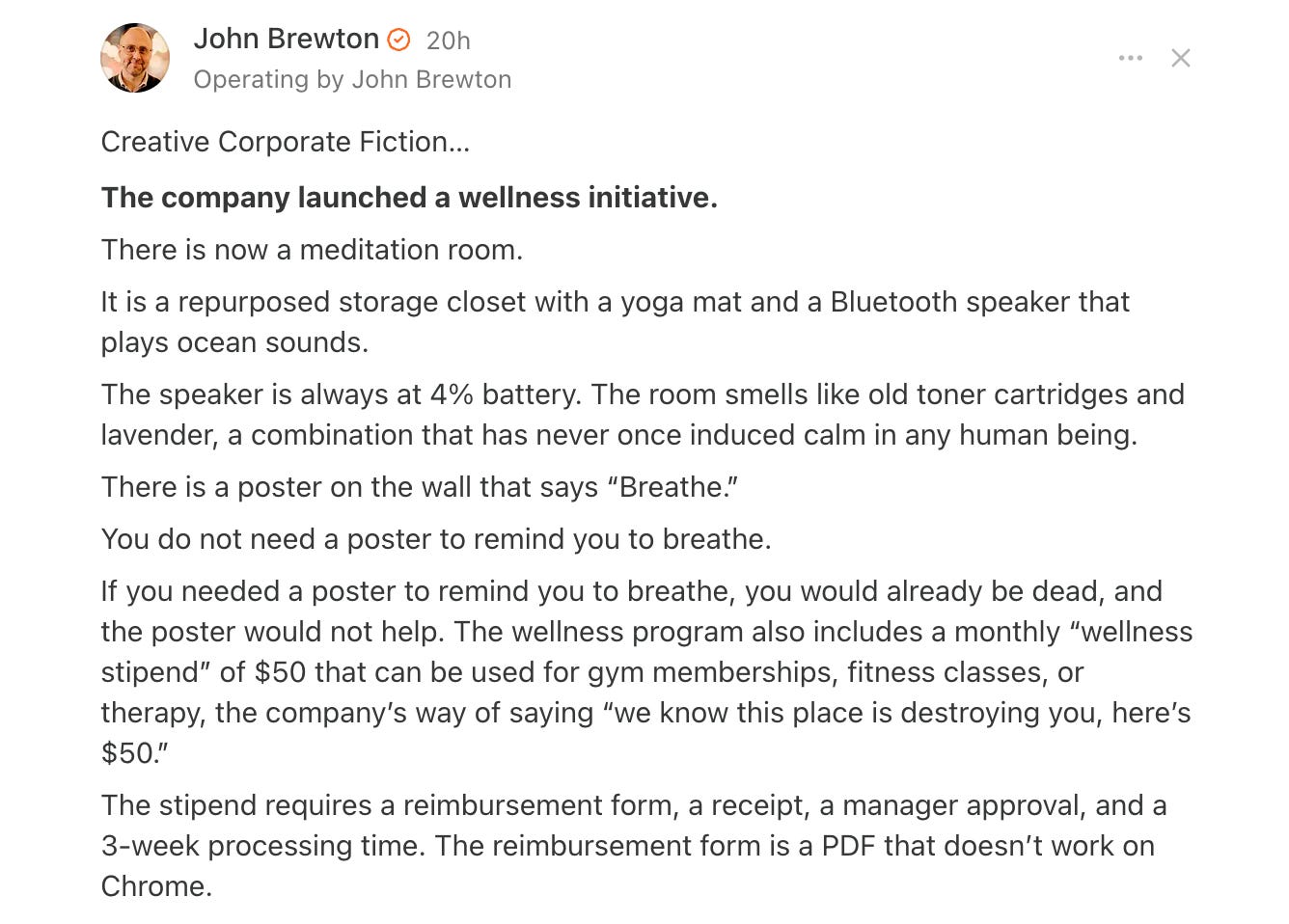
Small, windowless spaces tucked between offices. Fluorescent lights buzzing overhead. Occasionally a meditation cushion placed on the floor as if calm could be summoned through interior design.
My student tried using them.
She wanted the break. She NEEDED the pause.
But something about the rooms felt off. They didn’t signal safety to her nervous system. They felt like storage spaces where employees could briefly hide from stress rather than environments that actually supported regulation.
She stopped going.
This is what I call wellness theater—corporate gestures that acknowledge stress without addressing the conditions that create it.
Because nervous systems do not regulate in isolation.
They regulate in environments.

What Actually Calms a Nervous System
Stephen Porges’ Polyvagal Theory explains that our autonomic nervous systems are constantly scanning the environment for cues of safety or threat. This process—what Porges calls neuroception—happens beneath conscious awareness.
Natural light signals safety.
Human connection signals safety.
Predictable rhythms signal safety.
Windowless closets do not.
And neither do workplace cultures that expect employees to answer Slack messages at midnight.
You cannot out-meditate a culture of urgency.
And you cannot restore nervous systems with symbolic gestures.

Slowness as a Form of Intelligence
This is why John Brewton’s note stayed with me.
Thoughtfulness is not simply an intellectual virtue.
It is a biological necessity.
The kind of thinking that produces durable ideas requires a nervous system that is not constantly defending itself against stimulation. It requires slowness.
And slowness has become suspicious in modern culture.
We treat it like inefficiency.
But the most meaningful work—whether writing, leadership, or parenting—rarely emerges from frantic environments.
It emerges from space.
Space to observe.
Space to reflect.
Space to let ideas develop rather than react to the next thing demanding attention.
In that sense, thoughtful writing is not just communication.
It is a form of nervous system regulation.
When I read John’s work, I recognize the time that went into it. Someone sat with those ideas long enough to make sure they held weight before sending them into the world.
That kind of care is rare now.
And it makes me wonder about something larger.
If thoughtful minds require slower environments—and slower environments support healthier nervous systems—what would it look like if we designed our workplaces, technologies, and daily lives around that truth instead of pretending a meditation cushion in a closet is enough?
Thank you for reading and being with me.
Lane
P.S. If you’re new here, I teach practical nervous system regulation through meditation, breathwork, and daily practice. You can explore the Calm Lab and my guided practices here.
