

We tried to get Violet across the country during a pandemic. Let me just say this: never again.
Heat waves in the South.
Flight restrictions.
Lockdown protocols.
Text messages that felt like hostage negotiations.
And then — finally — she arrived.
Lean long legs. Elegant. Slightly suspicious. Already assessing us like we were applicants.
She changed the energy of our house in 48 hours.
I was so thrilled with her that I briefly entertained the idea that she would be my dog.
That lasted about a week.
Because while I was out in the field working, my husband was home during lockdown. Guess who she imprinted on?
Not me.
Rude.
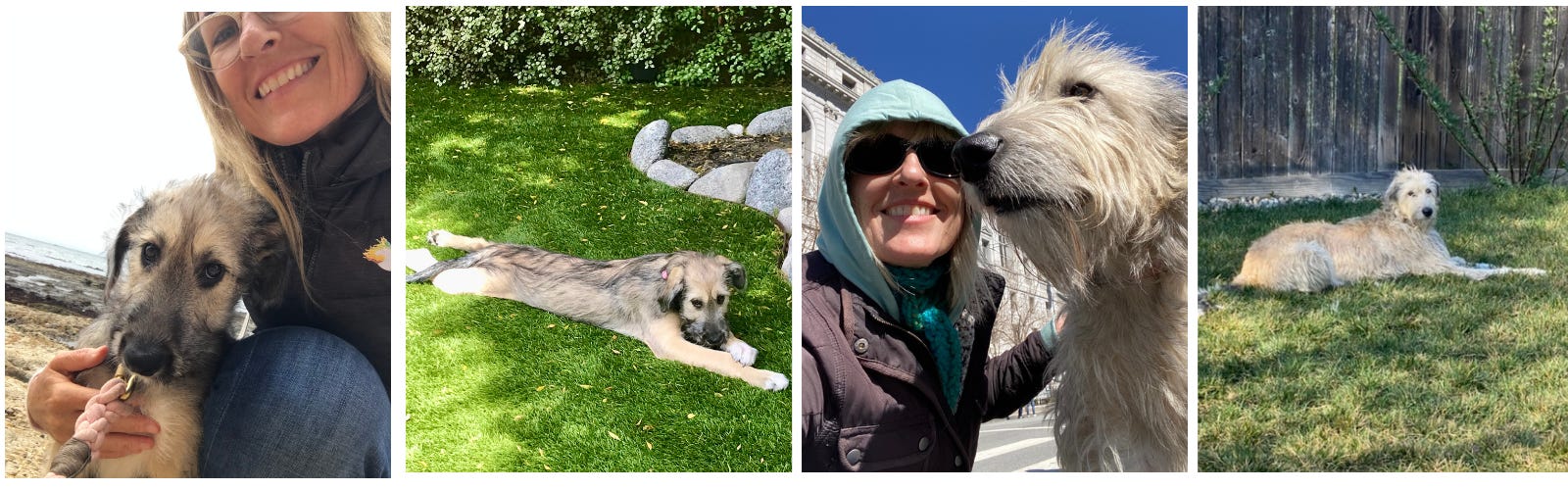
Violet: Aloof Royalty in a 140-Pound Frame
Violet came from the South. She has presence. She stands on her own. She does not need constant reassurance. She is precocious and a little standoffish — which, frankly, mirrors my husband’s personality at 100%. I guess that's why she really is his dog.
She meditates. She really does.
I taught her during those early pandemic mornings when the world felt unstable and I needed something — anything — predictable. She’d lie next to me during breathwork. Long exhale. Soft eyes. Vagal tone through the roof.
She doesn’t practice with me anymore. She’s moved on, so very Gen Z of her.
She hates the vacuum. Tolerates the blender. Hounds at 10 a.m. daily for reasons only she understands. It’s loud. Three houses down loud.
My neighbors are saints.
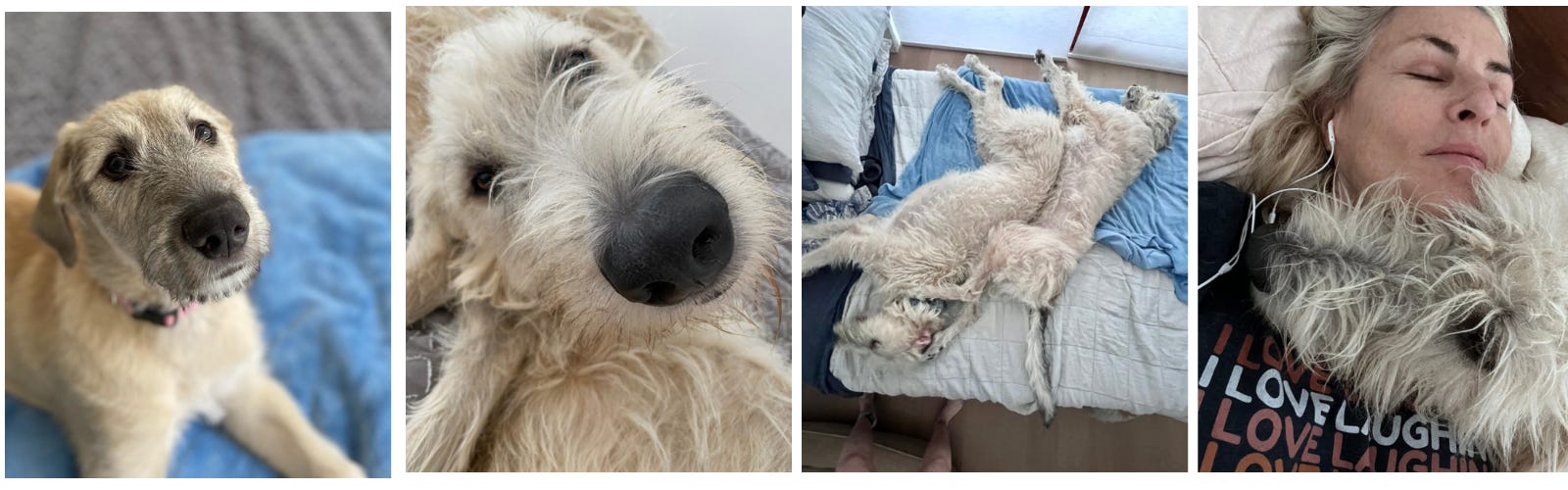
Enter Magnus: 155 Pounds of Drool and Devotion
When Violet attached to my husband, my nervous system did what it does best.
Strategized.
I wanted a cream or white male. No gray. No wheaten. I did not want to fly another dog across the country. Instagram — bless and curse it — helped me locate a breeder three hours away.
About nine months later, we picked up Magnus.
He was only eight weeks old when we were allowed to pick him up, omg, so adorable.
We took him from his mother early. And now he has an obsessive licking habit. It's Constant. Furniture. Air. Himself. Me.
From a regulation perspective, it makes sense. Licking releases endorphins. Self-soothing behavior. Dogs shake to discharge stress (see Temple Grandin’s work on mammals and nervous system reset). Magnus licks.
He weighs 155 pounds. Pure love. And slobber. And hair.
He will eat apples, cucumbers, mozzarella, chicken off the counter, and always attempt to eat the toilet paper holder, or paper towel holder after being discarded.
He meditates with me daily.
When I sit, he folds himself beside me like a prehistoric rug. Breath syncing. Massive rib cage expanding. He is my weighted blanket with a pulse.
If you’d told me 20 years ago — back when I was paying my first car payment and burning mixtapes — that one day my most consistent co-regulation partner would be a giant cream wolfhound named Magnus, I would have laughed.
Now? He is a non-negotiable.
Dysautonomia, Walks, and The Look
Since developing dysautonomia, our walks have waxed and waned.
There are days I can do two miles.
There are days I can barely do two blocks.
They look at me like, “We are still here. What is happening?”
And here’s the thing I love about them: adaptability.
No resentment. No existential crisis. Just recalibration.
They lie down. They wait. They’re ready when I am.
Predictable companionship lowers sympathetic tone. That’s not sentiment. That’s physiology.
Why Dogs Are Nervous System Gold
Human-animal interaction research is robust.
A 2012 study in Psychosomatic Medicine found that pet owners had lower resting heart rates and blood pressure compared to non-owners — and recovered faster from stress tasks (Allen et al., 2012).
Oxytocin increases in both dogs and humans during mutual gaze (Nagasawa et al., Science, 2015). Oxytocin dampens HPA axis activation. Translation? Less cortisol. More parasympathetic activity.
Heart rate variability improves during calm pet interaction (Beetz et al., 2012). HRV is a proxy for vagal tone.
Longevity data from the American Heart Association (2013) suggests pet ownership is associated with reduced cardiovascular mortality.
We talk about nervous system regulation like it’s abstract.
Magnus is literal.
He grounds me.
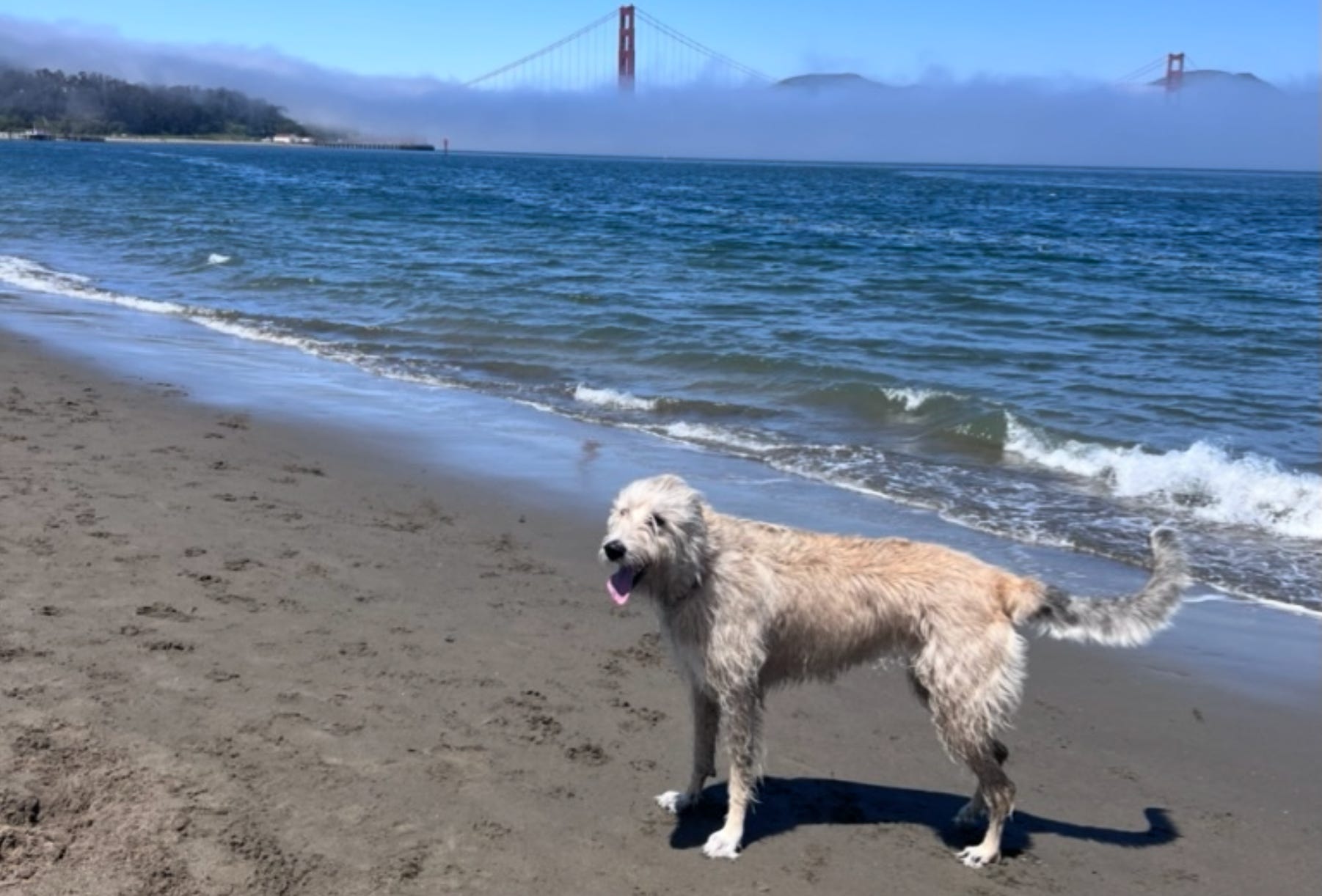
10 A.M. Hounding and Existential Questions
Every morning at exactly 10 a.m., they hound.
No mail truck. No visible stimulus.
Just a primal announcement.
It echoes down the block. I imagine my neighbors bracing for it like a scheduled alarm.
I’ve tried to train it out of them.
Mixed results.
Violet does not like the vacuum. Magnus doesn’t care. He’s too busy existing in bliss.
He always moves when my son comes downstairs. Yields space. Takes the floor. Knows his place in the hierarchy.
Last rung. Happiest dog alive.
There is something deeply regulating about watching an animal that simply does not carry narrative stress.
No shame.
No future planning.
No doom scrolling.
Just appetite. Rest. Contact.
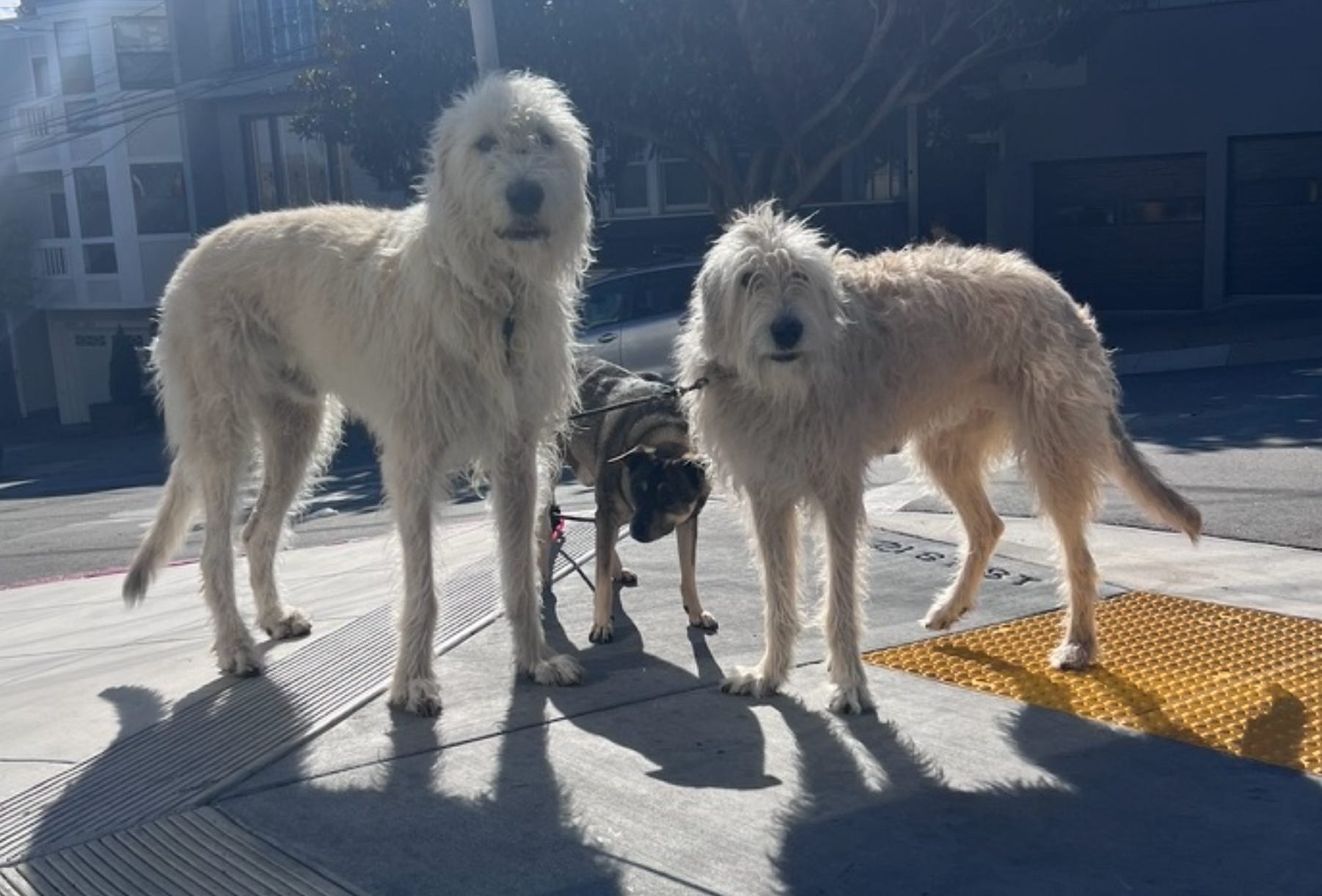
Percy, Carolyn, and Grief in Dogs
Recently, Magnus met Percy — my friend Carolyn’s dog.
Carolyn has since passed.
Our walks have shifted. There’s a rhythm missing.
I sometimes wonder if Magnus senses the absence. Dogs detect changes in scent patterns, cortisol shifts in their humans, routine disruptions.
They know.
Their nervous systems are exquisitely tuned to ours.
Which brings me to something important:
Animals regulate us.
But we regulate them, too.
When I’m dysregulated, they’re restless. When I’m calm, they settle faster.
Mirror neurons are not just a human phenomenon. Emotional contagion is biologically conserved across mammals.
We co-create safety.
The Couch Takeover
They have taken over my couch.
It is technically furniture.
Functionally? Dog throne.
Every night Violet lies there while my husband combs her. Gently. Methodically. In a way I’ve never seen him care for anything else — possibly not even his own child.
Magnus curls beside us. When my son enters, he shifts. Makes room.
There is something sacred about this nightly ritual.
Predictability. Touch. Grooming. Eye contact.
It is polyvagal therapy disguised as domestic life.
Recovery, Regulation, and 155 Pounds of Love
I’m in long-term recovery. I know what dysregulation feels like. I know what it is to live with a nervous system that does not cooperate.
These dogs have saved my life.
Not dramatically. Not in a headline way.
In daily increments.
Walk by walk.
Breath by breath.
Slobber drop by slobber drop.
Regulation is repetition.
And animals are masters of repetition.
Eat. Walk. Rest. Connect.
They don’t complicate it.
We do.
A Question for You
If you have an animal, I want to see them. Share them with me.
And tell me this:
When you’re stressed, do they move closer — or farther away?
That answer tells you more about your nervous system than any wearable ever will.
Thanks for being here.
Magnus is licking the coffee table as I finish this.
Violet is watching him.
Life is good.