

There are many experiences that fracture logic.
Death is one of them.
One day, a person exists inside your daily reality — walking beside you, laughing with you, regulating you — and the next morning, they do not. No gradual transition. No nervous system preparation. Just a hard discontinuity that the brain cannot metabolize.
This is not simply emotional. It is neurological.
Grief is often described in poetic language — waves, ache, heaviness — but underneath those metaphors is something far more mechanical and far more destabilizing: the sudden removal of a regulatory presence your body had begun to depend on. My body had landed with my friend, Carolyn, she granted me a space to find myself.
I only met her about nine months ago, when my nervous system was barely holding together. Dysautonomia had shrunk my world. My body did not behave. My physiology did not feel trustworthy. I was fragile in the most literal sense — the kind of fragility where walking outside feels like a high-risk activity.
And then she appeared.
Not dramatically. Not ceremonially. Just a steady, grounding presence who did something profoundly stabilizing: she treated my brokenness as normal. She took me on walks when leaving my house felt impossible. She sat with me inside the strange physics of nervous system illness without trying to fix, diagnose, or rush me, or my system.
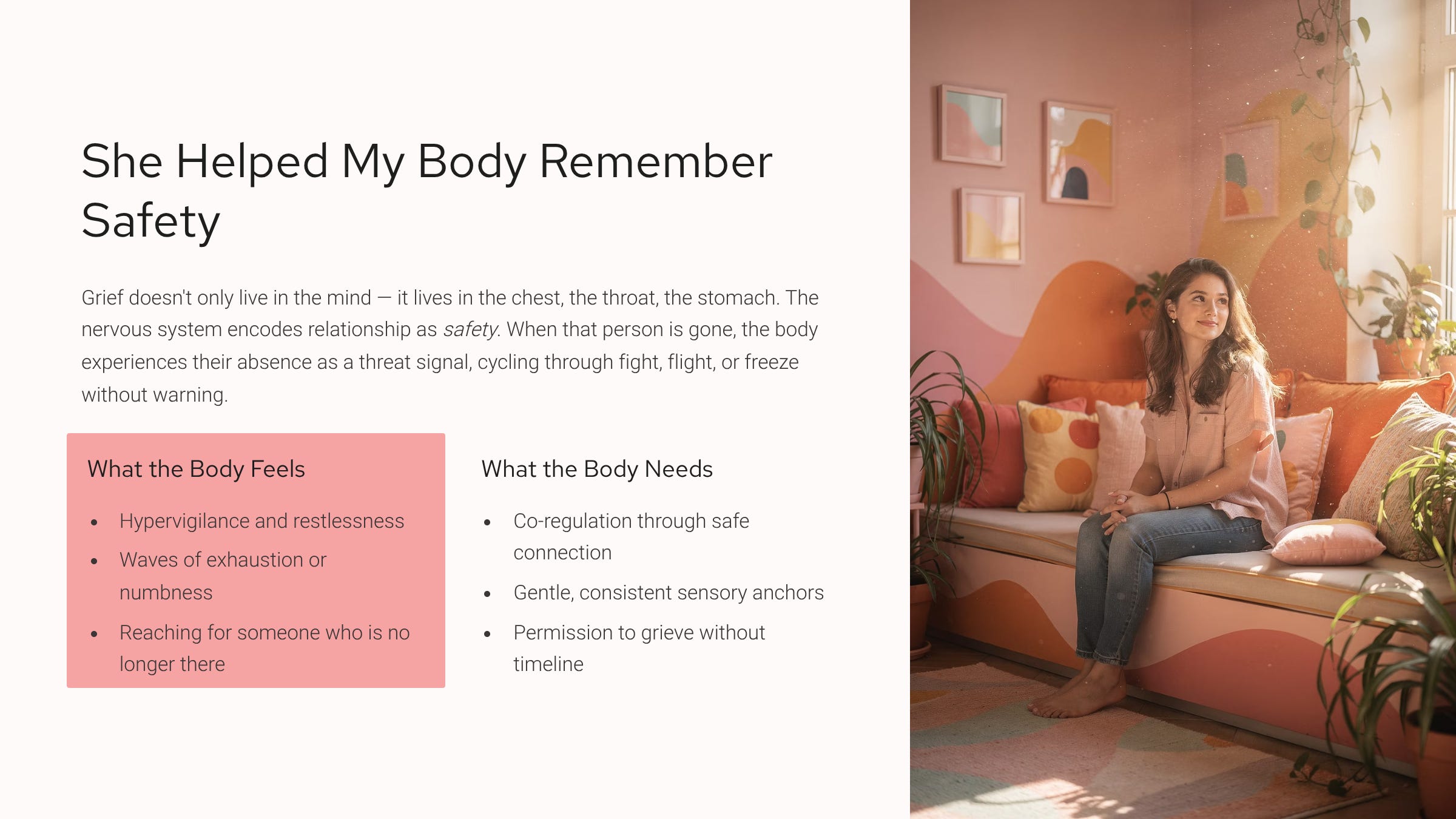
She helped my body remember safety.
Then came a text and a series of phone calls.
I had just been with her the night before. Reality still contained her voice, her movements, her ordinary aliveness. The next day, I was told she was gone. Not “unwell.” Not “recovering.” Gone.
My brain rejected this at first. It searched for clerical errors. Miscommunication. Alternate explanation. Because, from a nervous system perspective, the event makes no sense. The world does not usually erase a person between two sunrises.
My nervous system began to crumble.
And this is the part that matters: it did not collapse.
If you live with autonomic instability, you understand the fear here. Acute shock, emotional devastation, loss of safety — these are precisely the conditions that can trigger physiological spirals. I was not just grieving her. I was terrified of my own biology.
But survival, I’ve learned, is rarely dramatic. It is procedural.
I did the least glamorous, most effective thing available: I reached for other nervous systems. People who loved me. My son held me while my body tried to make sense of the impossible. I kept breathing — not metaphorically, but deliberately, because breath is one of the few levers we can pull when everything else feels uncontrollable.
Co-regulation is not sentimental. It is biological first aid.
Grief, especially for sensitive or injured nervous systems, is not something you “power through.” It is something you move through with extraordinary gentleness and precision.
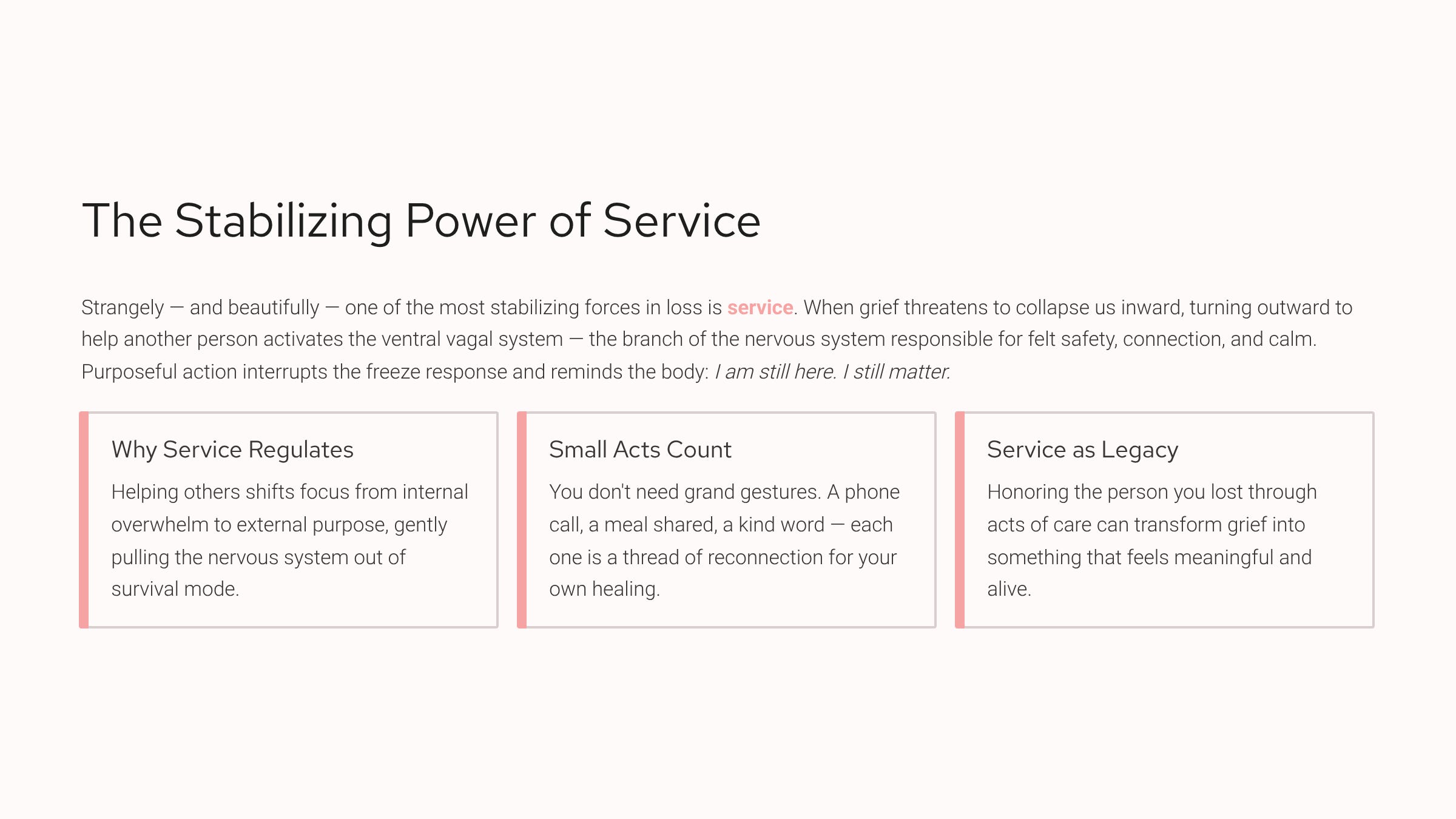
And strangely, one of the most stabilizing forces in loss is service.
In the days that followed, I found myself doing what I imagine she would have wanted me to do — small, ordinary acts that tethered me to the living world. I baked macaroni and cheese for her son. Made her Current and Lemon Scones. I brought food to their house. I offered to walk the dogs, water the plants, and carry some tiny fraction of the unbearable logistical weight death leaves behind.
Not distraction. Regulation.
Service creates structure when reality feels structurally unsound. It provides movement without overwhelm, connection without emotional interrogation. It is the nervous system’s way of saying: life is still occurring, and you are still part of it.
I returned to the beach.
Not for symbolism, but because my body knows something my intellect occasionally forgets: rhythmic sensory environments regulate human physiology. The sound of waves, the horizon line, the negative ions, the simple predictability of nature — these are not indulgences. They are regulatory inputs.
I hydrated with almost religious consistency. Grief dehydrates. Stress burns through fluids. A dysregulated nervous system is far less resilient inside a chemically unstable body.
I kept teaching. Showing up. Staying connected to purpose.
Not because productivity cures grief — it does not — but because identity continuity matters. Loss already destabilizes reality. Abandoning every routine compounds the shock.
Grief is universal. Regulation is individual.
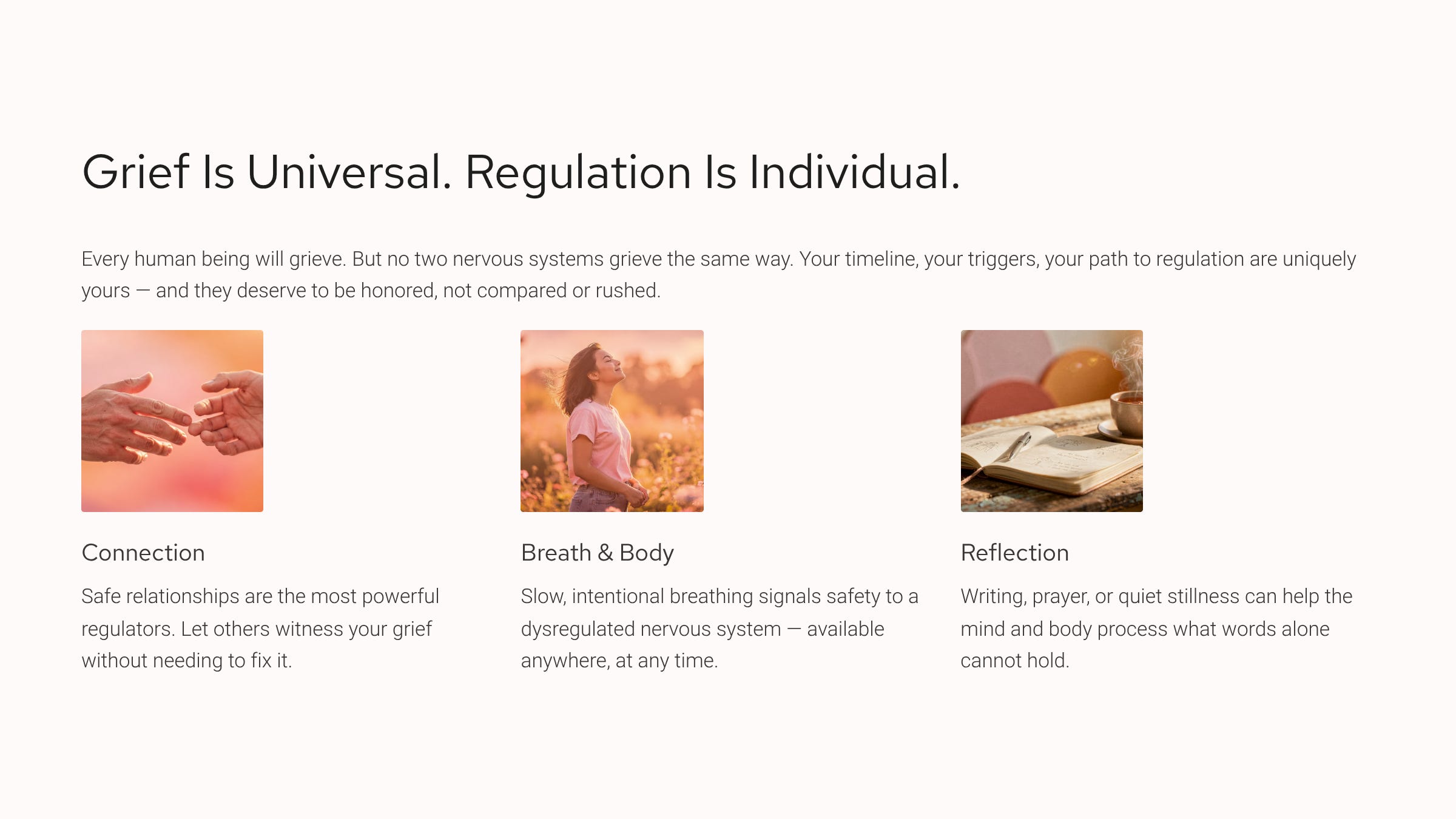
One of the most disorienting aspects of death is witnessing how differently humans respond to it. Some people collapse inward. Others become hyperfunctional. Some need silence. Others need narrative. None of these reactions are wrong. They are nervous systems improvising.
Accepting this — truly accepting it — prevents a secondary and unnecessary stressor: the belief that there is a correct way to grieve.
There isn’t.
There is only the way your organism processes rupture.
For fragile nervous systems, the goal is not emotional suppression or forced resilience. The goal is physiological stability while grief runs its course.
A few anchors help:
1. Borrow stability whenever possible
Do not attempt solitary heroics. Seek safe humans. Safe spaces. Regulated environments. Your nervous system is not designed to process shock alone.
2. Prioritize the body’s basics ruthlessly
Hydration, blood sugar stability, sleep protection, gentle movement. Grief is metabolically expensive.
3. Reduce additional stress inputs
This is not the week to overhaul your life, interrogate your future, or make irreversible decisions. Neurological storms distort perception.
4. Use rhythm as medicine
Walking, breathing practices, ocean sounds, repetitive physical tasks — rhythm signals safety to the autonomic system.
5. Allow meaning without forcing it
The brain will eventually construct narrative. It does not need to do so immediately.
Most importantly: survival inside grief is not measured by how composed you appear. It is measured by whether you continue to care for your organism while reality rearranges itself.
There is no tidy philosophy that makes death “make sense.” There is only the deeply human task of remaining here — breathing, regulating, connecting — while loving someone who is no longer physically present.
And sometimes the most stabilizing compass is heartbreakingly simple:
What would they want for me right now?
For me, the answer has been clear. Care for the body. Stay near beauty. Continue the work. Offer kindness. Remain in service. Stay tethered to life.
If you are navigating loss, shock, or nervous system fragility, you do not have to figure this out alone.
I’m hosting a masterclass on nervous system regulation — practical tools for stabilizing your physiology when life becomes too much, too sudden, too heavy.
Because grief is inevitable.
Collapse is not.
And regulation is a skill we can build — even, and especially, in the moments that feel impossible.
