

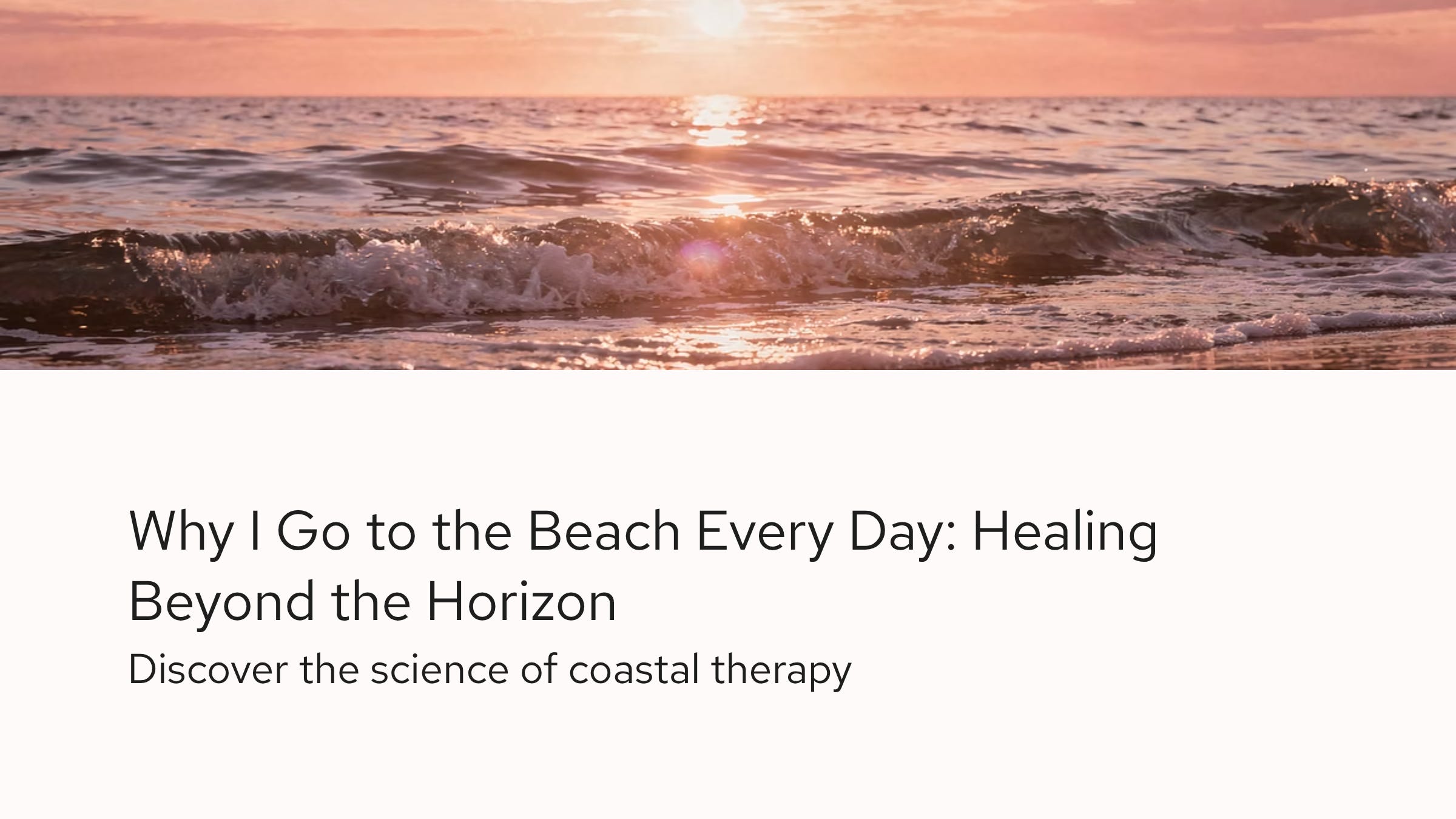
I don’t go to the beach to relax.
I go because my nervous system needs a place where it doesn’t have to perform.
In a culture obsessed with optimization—steps, metrics, routines—the idea of sitting still, doing absolutely nothing, can feel irresponsible. Indulgent. Unproductive. And yet, for bodies living under chronic stress (that is, everyone on the planet), overstimulation or trauma may be the most intelligent intervention we have.
I live 15 minutes away from the beach. When my son was young, we went to the zoo every Friday—the ocean sits right behind the zoo. Over the years, I would think to myself, "I should… go to the beach," yet I would end up grinding away at my desk, completing every lame task I had, creating the perfect storm that finally landed me in crisis. Now, I am committed to the beach every day, not because it’s pretty—though it is—but because it is one of the few environments that reliably downshifts my nervous system without asking anything of me in return.
The Ocean Has a Rhythm Your Body Recognizes
The ocean moves in slow, predictable cycles. In. Out. Pause. Repeat.
Your nervous system is built to respond to rhythm. Long before language, before logic, before calendars, regulation came from patterned sensation: breath, heartbeat, movement, sound. The waves provide all of it—without demand.
Research in neuroscience and trauma physiology has shown that predictable, repetitive sensory input helps the autonomic nervous system move out of chronic fight-or-flight. This is why rocking soothes infants. Why slow walking regulates adults. Why breathing practices work when they’re gentle and rhythmic instead of forced.
The ocean does this passively.
You don’t have to breathe a certain way.
You don’t have to “drop in.”
You don’t have to process anything.
Your body listens anyway.

The Colors Matter More Than We Admit
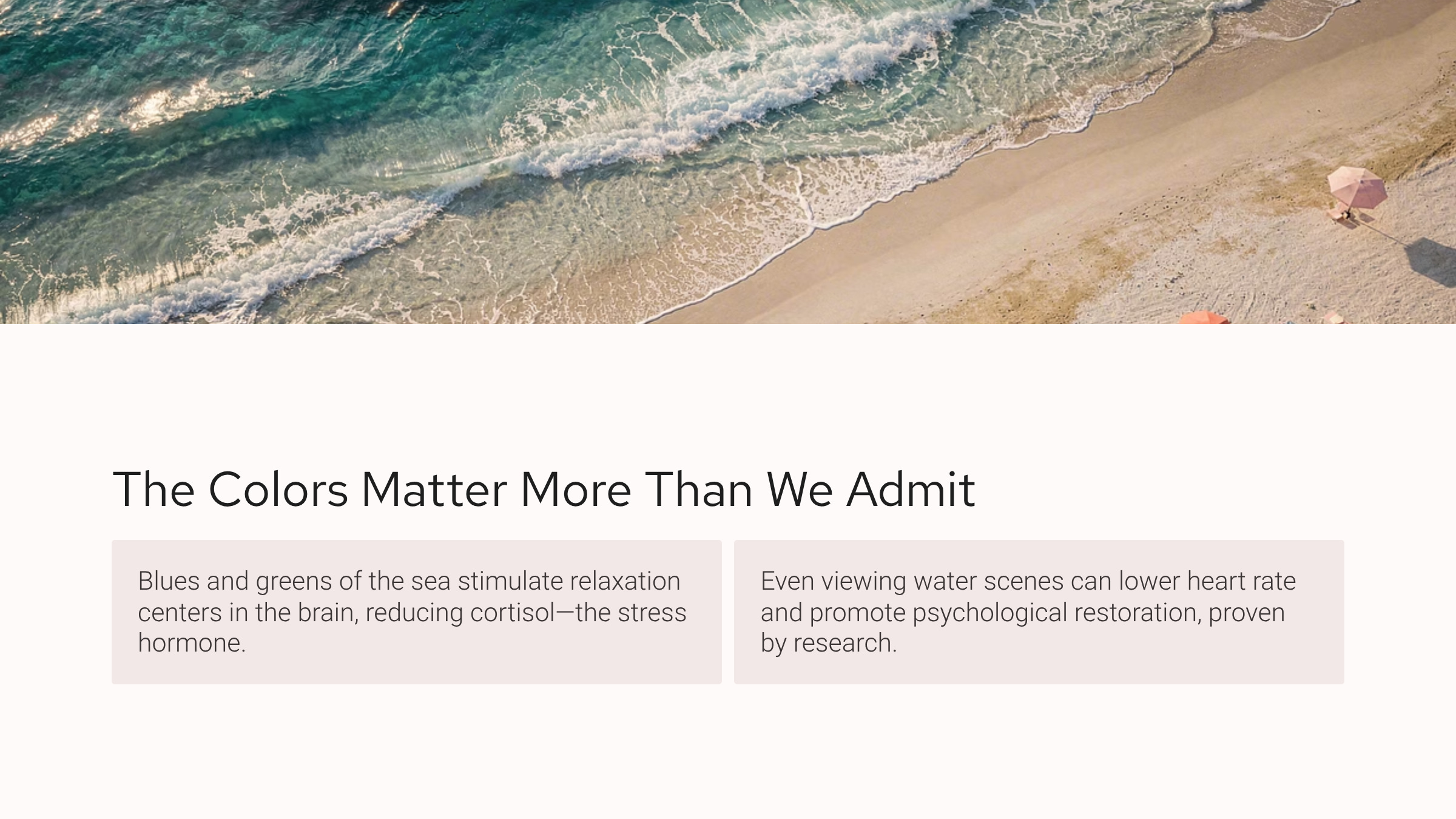
There’s a reason blues and greens dominate recovery spaces.
Studies in environmental psychology show that cool color palettes—especially blues—reduce sympathetic nervous system activation, lowering heart rate and perceived stress. The horizon line itself offers something rare in modern life: visual continuity. No pop-ups. No alerts. No edges demanding attention. This is the magic!
At the beach, my eyes soften. Peripheral vision widens. The nervous system receives the signal: there is nothing to track right now.
For people living with chronic stress, trauma histories, or long-term nervous system activation, this widening is not aesthetic. It’s biological relief, trust me on this.
The Absence of People Is Part of the Medicine
Or maybe it’s the right kind of people: strangers, dispersed, unengaged, not requiring response. I don't have to speak to anyone; the surfers are beyond my reach, the fishermen are knee high in the ocean, and those who are nearby are vacillating in the solitude.
Social stress is one of the most underestimated nervous system burdens. Being watched. Being needed. Being perceived. Even pleasant interactions carry a physiological cost.
At the beach, no one needs anything from me. No one is asking who I am, what I do, or how I’m doing. I don’t have to explain myself. I don't have to excuse myself or even make petty conversation. My body gets a break from social vigilance.
That matters more than we’re taught to believe.
Sitting Still Is Not Passive for a Traumatized Body
Trauma is not just memory. It is stored physiological pattern.
As described in The Body Keeps the Score, trauma lives in muscle tone, breath restriction, posture, and startle response. It shows up as restlessness, collapse, numbness, or chronic tension—not because the person isn’t “trying,” but because the nervous system learned to survive that way.
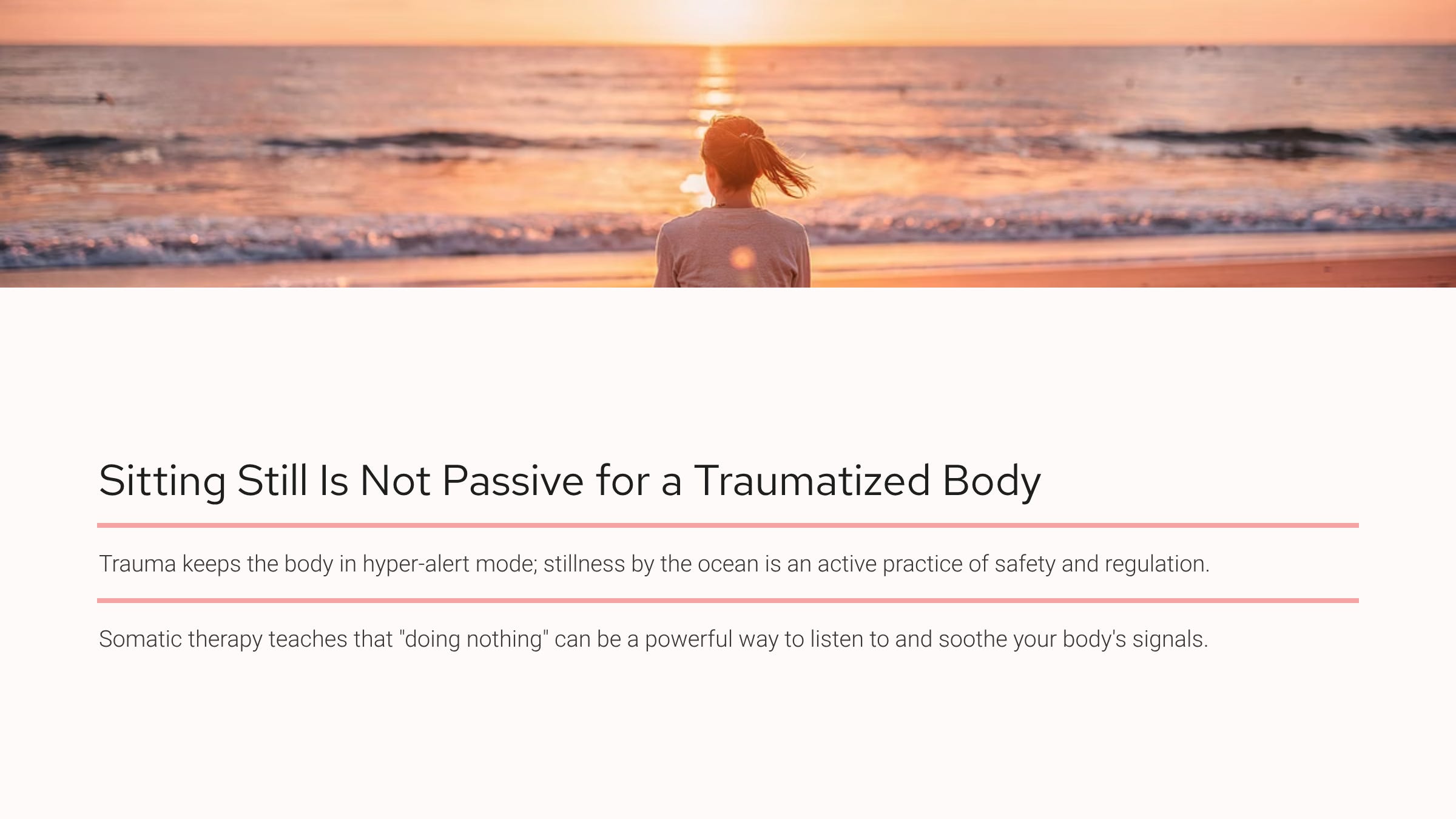
When the environment is safe enough, stillness allows these patterns to unwind—not through analysis, but through sensation.
At the beach, sitting becomes a kind of quiet negotiation:
your jaw softens
your shoulders drop
your breath deepens on its own
your body releases what it has been holding without even asking permission
This is not catharsis. It’s regulation.
And regulation is how trauma untangles—slowly, indirectly, without drama.
Polyvagal Safety Without the Buzzwords
Polyvagal theory describes how the nervous system constantly scans for safety or threat. Not consciously—automatically. Our nervous system is always on, think about that for a moment.
The beach offers multiple signals of safety at once:
rhythmic sound
open visual field
natural light
absence of sudden demand
predictable movement
All of this supports a shift toward the ventral vagal state—where connection, digestion, creativity, and repair are possible. This is the state where you feel calm, good, like you matter, and that you are good!
You don’t have to understand the theory for your body to benefit from it.

Doing Nothing Is Doing Something
One of the most radical acts in stress management is allowing the body to complete its own cycles.
Not fixing.
Not optimizing.
Not reframing.
Just sitting.
When I sit at the beach, I’m not meditating in the traditional sense. I’m letting my nervous system do what it already knows how to do when it’s not interrupted.
This is why I built Calm Lab the way I did—not as a productivity tool or a self-improvement program, but as a space where people can learn what regulation actually feels like. Where stress isn’t solved, but metabolized. Where stillness isn’t forced, but received.
The beach taught me that first.
The Quiet Truth
Stress doesn’t leave the body because you understand it.
Trauma doesn’t unwind by analyzing it.
Regulation doesn’t come from effort.
It comes from enough safety, for long enough, without demand.
For me, the beach provides that—daily, consistently, without agenda.
I don’t go to relax.
I go to remember what my nervous system feels like when it’s allowed to exist.
And that, it turns out, is the foundation of everything else.