Something has shifted in America.
More people are choosing not to drink than at any point in recent memory. Alcohol consumption is down among younger adults. “Sober curious” has entered the mainstream. Non-alcoholic spirits now occupy entire aisles, and there are even bottleshops that sell only non-alcoholic products. Abstinence, once whispered, is increasingly spoken aloud — sometimes proudly, sometimes experimentally, often without a dramatic backstory.
That would have been unthinkable when I got sober.
In the 1990s, drinking wasn’t just normal — it was aspirational. Alcohol meant access, glamour, belonging. I was hustling, modeling, and earning more income in a year than my parents ever did. My drinking career was being written about and produced for a television show. I had no idea that alcohol was my problem until it was! Sobriety wasn’t a wellness choice or a lifestyle experiment. It was something you did after you lost everything — quietly — and only if you were lucky enough to land in the right rooms.
I was lucky.
I got sober in West Hollywood in the 90s, surrounded by people with celebrity, Oscar, and Grammy credentials tucked into their pockets like proof of survival. Sobriety wasn’t cool, but it was real. No podcasts. No branding. Just church basements, late-night coffee, and people who had burned their lives down and somehow lived to talk about it.
That context matters. Because sobriety doesn’t exist outside culture — and it doesn’t stay the same over time. I had no idea when I got sober that so much would change.
I’m coming up on thirty years of sobriety. I’ve lived multiple lives inside that sentence. And what I’ve learned is this: control can get you sober, but it cannot keep you sober — not through the long haul of an actual human life, let me break it down into years.
Years 1–5: Escape Velocity
Right after 9/11, I left the country.
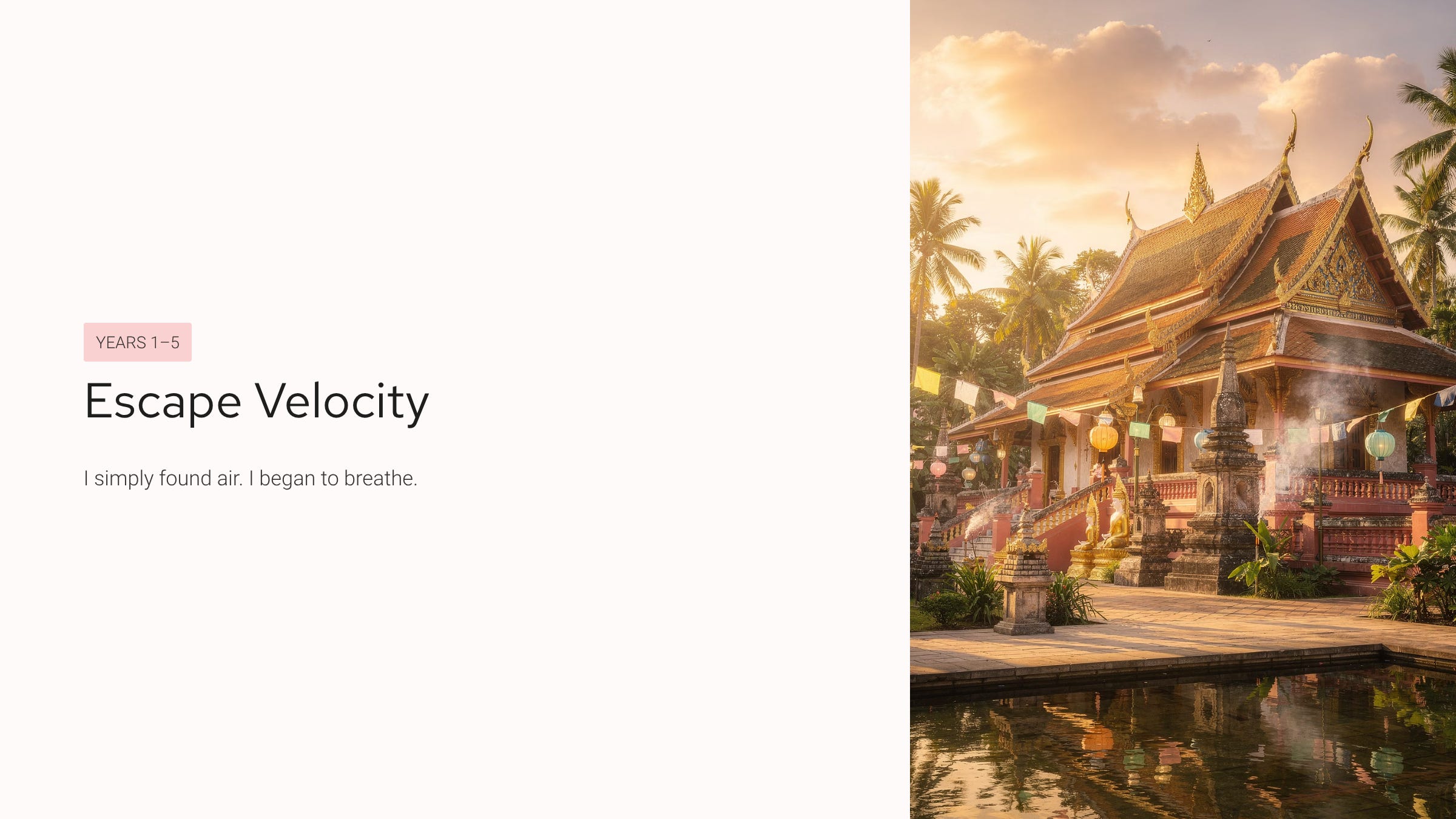
Not metaphorically. Literally. I landed in Bangkok, newly sober, alone, broke, and oddly free. I turned five years sober in a Buddhist watt, sitting in a mud bath, monks surrounding me, sleeping on a wooden pillow, eating ants, and language finally was irrelevant. I wrote a book. I lived quietly. I disappeared on purpose—to seek.
Early sobriety often requires distance—not insight. Not everyone has to have distance, but for me, it was a life-changer.
The science supports this instinct. In the first years of recovery, stress systems remain on high alert. Dopamine signaling is still recalibrating. Relapse rates in the first five years range from 40 to 60 percent, comparable to those of other chronic conditions. This isn’t a failure of commitment; every person I know who speaks these words, "I want to get sober," isn't by accident. Yet the instability of the nervous system and the individual’s own biology is catching up.
On another continent with little people who didn't look anything like me, I didn’t find enlightenment. I simply found air. I began to breathe.
Years 6–10: Learning How to Be Human
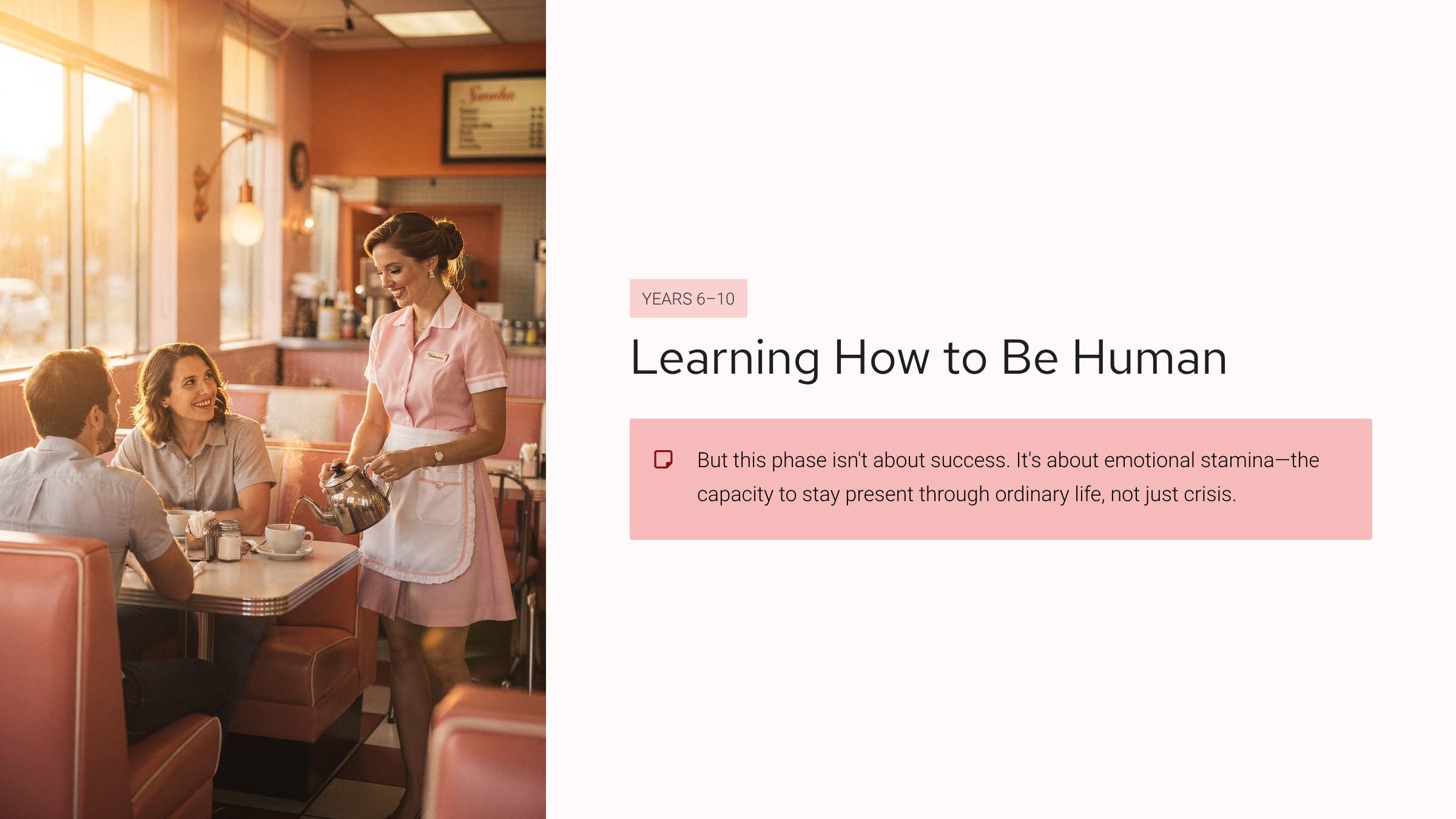
Seven years sober, I was back in the U.S., working at a breakfast diner in Boulder Colorago, of all places. I haven't told you this yet, but for the first part of my twenties I modeled, and I had a bank account that let me travel, but when I landed back Stateside… I was broke!
I fell head over heels in love—with a man. I was learning how to stay—how to tolerate intimacy without disappearing, how to live without the adrenaline of chaos. Sobriety stopped being about survival and started becoming about participation. I was engaged in my life and not running from it.
By nine years sober, I was back in San Francisco. The tech boom was exploding. I returned to modeling. I opened an agency, my bank account was back, my lifestyle was back, and my circle expanded. From the outside, sobriety seemed to have worked.
But this phase isn’t about success. It’s about emotional stamina.
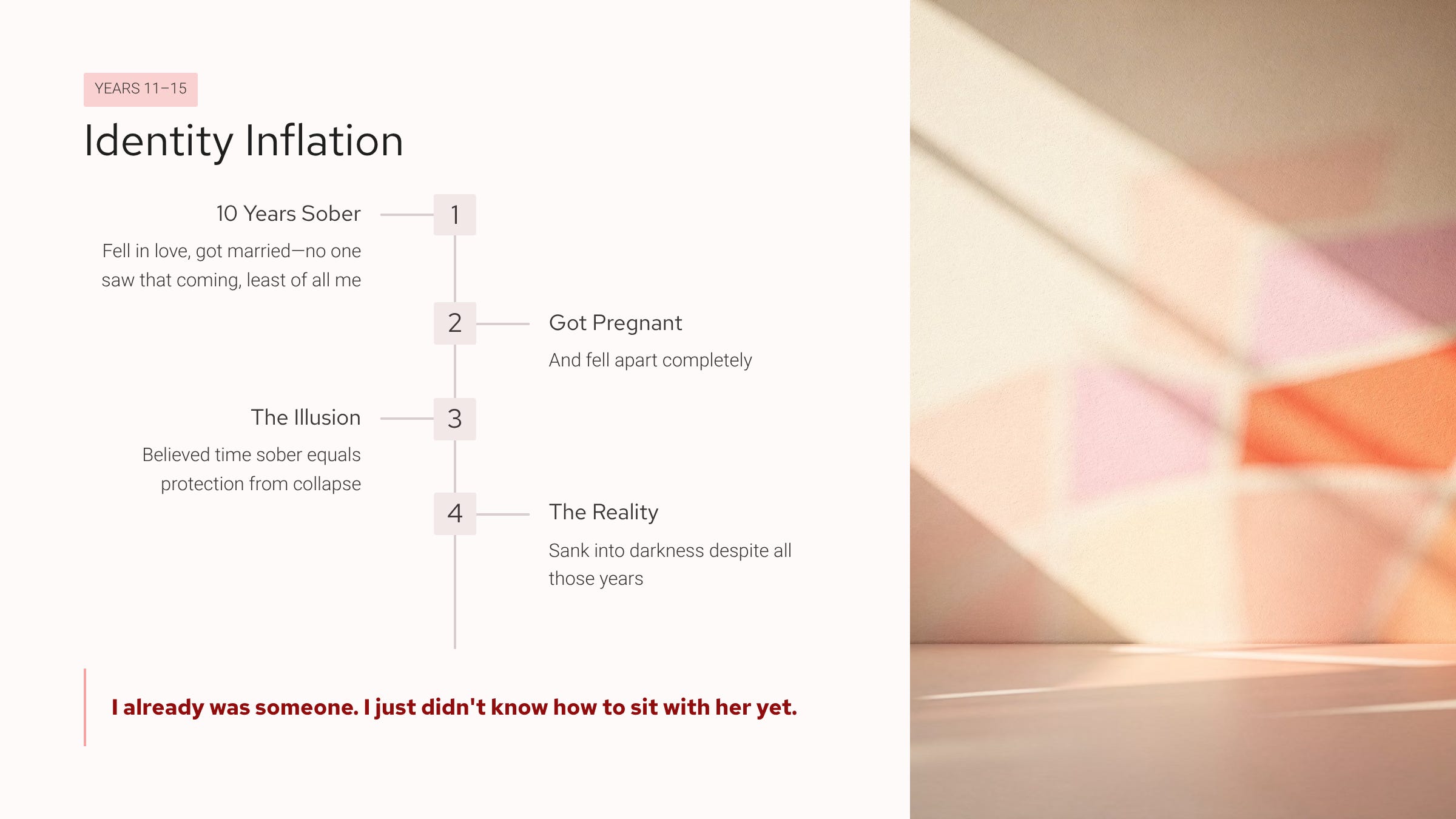
Years 11–15: Identity Inflation
At ten years sober, I fell in love again. Then — plot twist — I got married.
No one saw that coming. Least of all me.
I got pregnant. And I fell apart. My entire world felt like cold dark cave and I never had enough to keep warm.
This is the stage no one warns you about: the illusion of immunity. The belief that time sober equals protection from collapse. It doesn’t.
I sank. I wrote another book. I joined high-profile online masterminds. Hung out with online elites and created a rolodex of names, which I thought would mean something, but they didn't. I tried to become someone impressive enough to justify my survival.
The joke, of course, was on me.
I already was someone.
I just didn’t know how to sit with her yet.
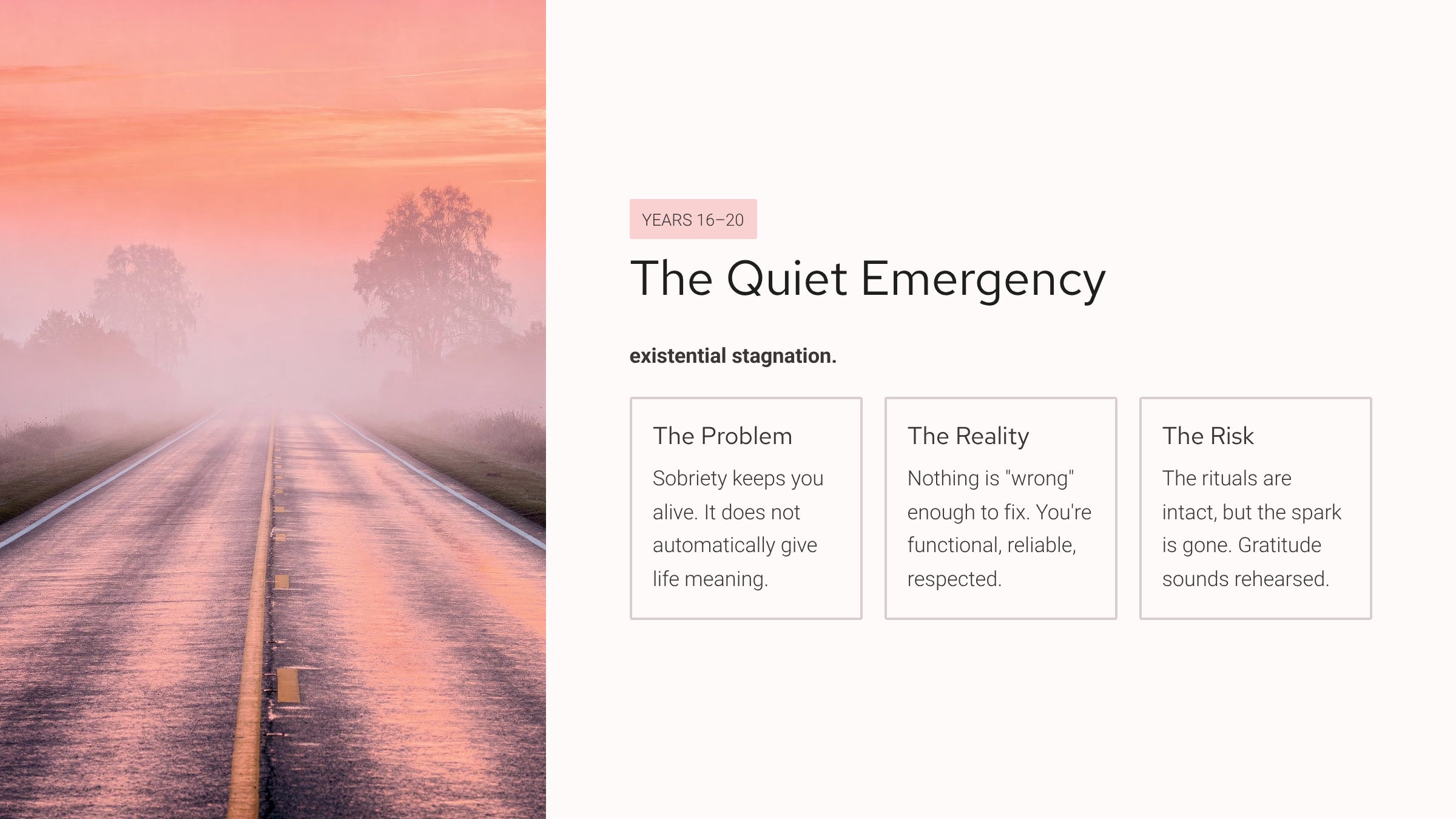
Years 16–20: The Quiet Emergency
Long-term sobriety statistics look optimistic here. After ten to fifteen years, relapse rates drop sharply — often below 15 percent. One begins to think, life is good, I’m done with the past. Yet this is where I see the most trouble: when life is full.
On paper, this is a success.
But another risk rises, one rarely discussed in recovery culture: existential stagnation!
Sobriety keeps you alive.
It does not automatically give life meaning.
This is the stage where nothing is “wrong” enough to fix. You’re functional. Reliable. Respected. Your rituals are intact, but the spark is gone. Gratitude begins to sound rehearsed. Life flattens. You step away from your recovery circle and step into your very own circle of life.
Many long-sober people stop growing — not because they want to drink, but because they don’t know what to grow toward. The danger isn’t relapse yet. The danger is emotional atrophy. Spiritual boredom. Living sober on autopilot.
No one talks about how lonely this phase can be.
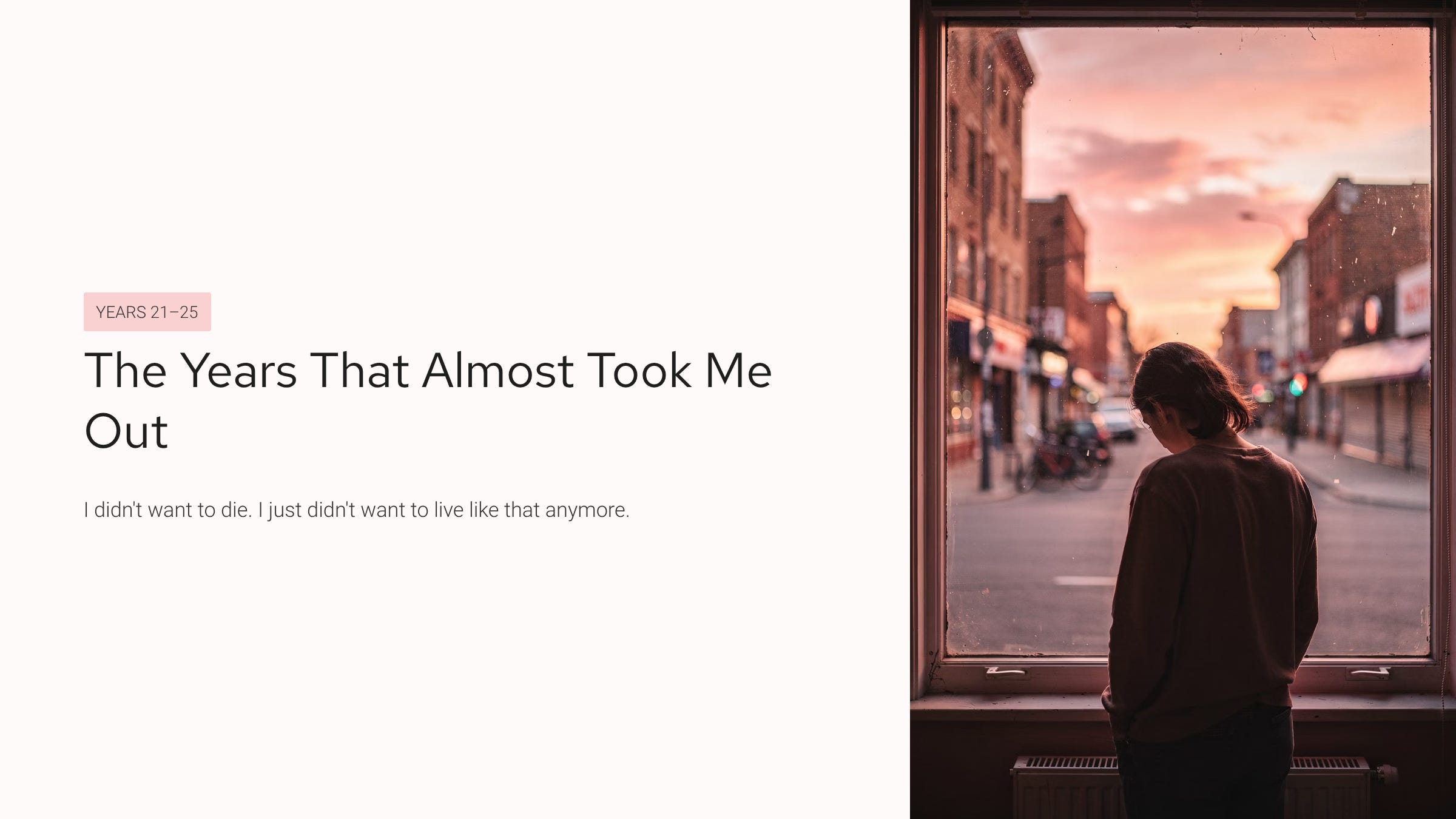
Years 21–25: The Years That Almost Took Me Out
Then came COVID.
I was married to a non-sober man, living in isolation with a grade-school child, cut off from community, rhythm, and relief. The days blurred. The nights stretched. Many people in my friend group disappeared during these years. Not dramatically. Quietly. They drank again. They left town. They stopped calling.
And I understood why.
This stage isn’t about craving alcohol — it’s about mental anguish. About living inside your own head without anesthesia while the world feels unsafe, repetitive, and unbearably small.
I didn’t drink.
But I lost fifteen years of abstinence. EATING.
I was off to the races with pistachio croissants, salt-and-vinegar potato chips, compulsion disguised as comfort. Fifteen months. Thirty pounds. I wanted off the planet. It was disgusting, lonely, and wow, was I hurting. I just didn't know how to acknowledge it.
This is the lie of modern sobriety culture: that relapse only counts if it’s alcohol. The body doesn’t care what substance you choose. It cares about relief. I needed relief.
I didn’t want to die.
I just didn’t want to live like that anymore.
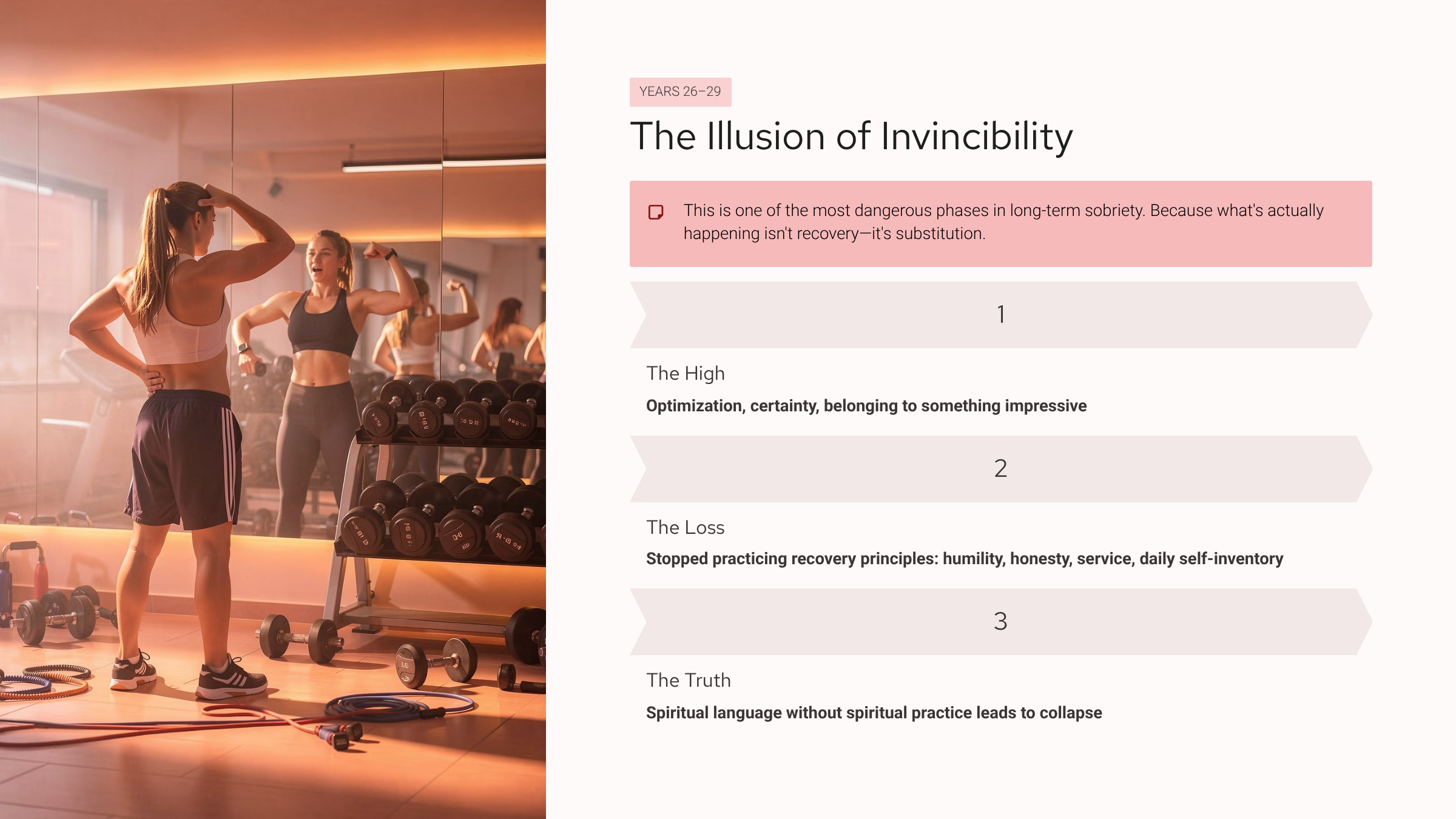
Years 26–29: The Illusion of Invincibility
At 26 years sober, I swung hard in the other direction. I needed to be different, to be seen, alive!
I lost weight. Found the gym. Found the guru. Found momentum. I felt activated, purposeful, chosen. I told myself this was growth.
I think this is one of the most dangerous phases in long-term sobriety.
Because what’s actually happening isn’t recovery — it’s substitution.
Instead of alcohol, my high became optimization. Certainty. Belonging to something impressive. I had spiritual language but had stopped practicing the principles of recovery: humility, honesty, service, and daily self-inventory.
Let me cut to the chase: if you haven't figured it out, recovery is spiritual—not religious, not performative—and when that core principle, that way of being, is replaced by adrenaline and certainty, collapse is inevitable.
Year 30: The Return
The last ten months have been the hardest of my sober life.
I lost my legs — metaphorically and nearly literally. There were days I didn’t think I would make it. Days I called my family to say goodbye. Days when I couldn't open my eyes, no eating, sleeping all day and night.
This is what long-term sobriety eventually asks of you:
Can you stay sober through illness, fear, loss, and collapse — without numbing, disappearing, or losing your mind?
Living sober through hardship is not for the faint of heart. I dug into my beginning days, I went back to stillness, back to my humble beginnings, back to sitting in silence.
I did not let go of my faith.
I remembered that the same force — God, Spirit, whatever name fits — that woke me up and got me sober decades ago could find me again here.
And it did.