

Somewhere along the way, we collectively decided that a well-regulated human is simply a well-controlled one.
Control your thoughts. Control your emotions. Control your reactions. Control your environment.
Preferably all before breakfast. We are control freaks!
It's an appealing way live. Control feels active, responsible, vaguely heroic. It suggests that if we are tense, overwhelmed, or internally chaotic, the solution is to tighten our grip — focus harder, manage better, discipline the mind into cooperation. When teaching class, I used to say, “Ÿou must learn to control your puppy!” (Puppy being the mind).
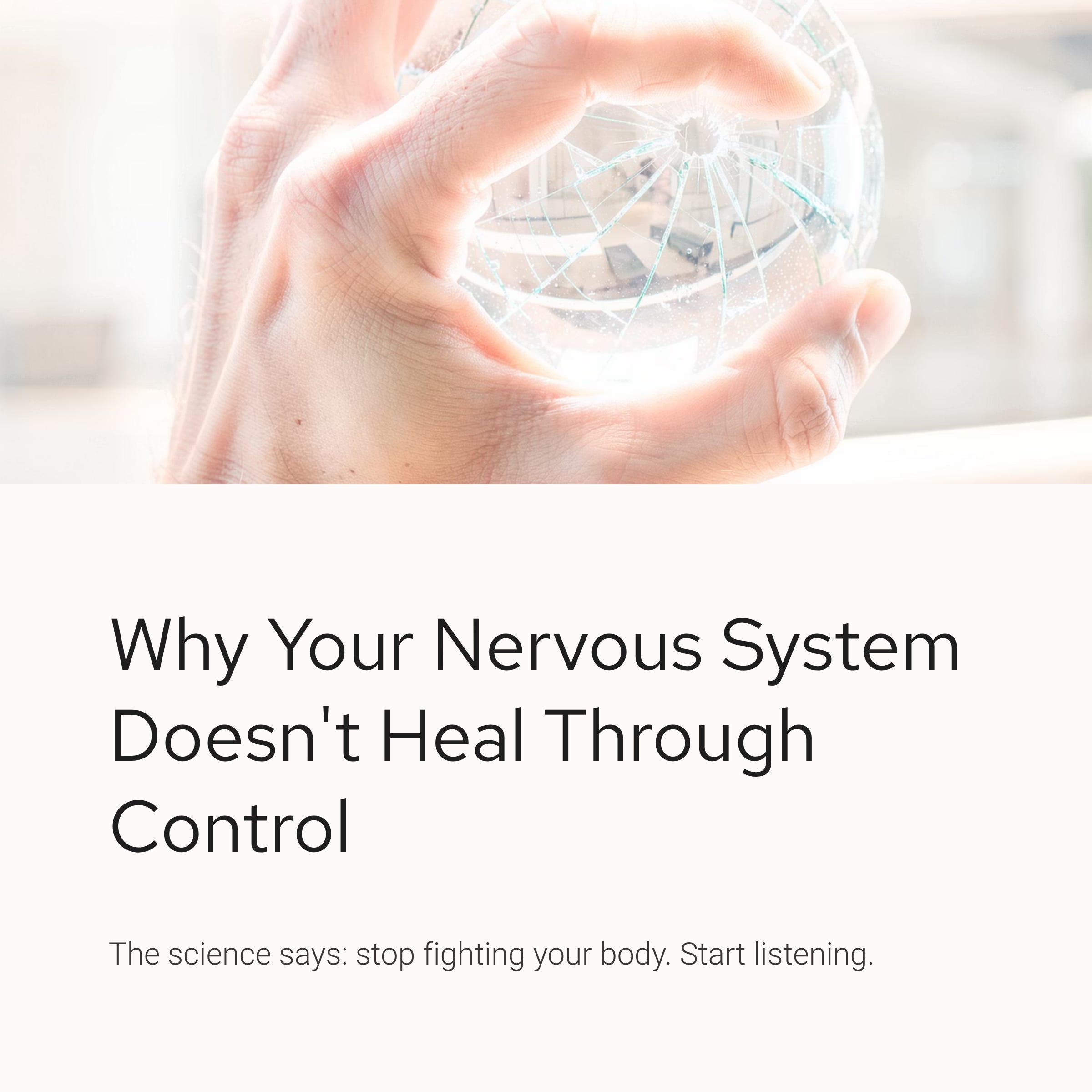
And yet, both lived experience and a growing body of psychological research point to a deeply inconvenient truth:
The nervous system does not equate control with safety.
In fact, excessive control often signals the opposite: what? Yes, up to this point, I had been teaching this all wrong, and my own nervous system proves this!
There is a strange paradox at the heart of human regulation. We tend to believe that the mind stabilizes the body, when, in fact, the body’s sense of safety determines whether the mind can stabilize at all. Under stress, cognitive effort becomes more difficult, not more effective. Trying harder frequently produces diminishing returns, like pressing the gas pedal while the engine is already flooded, and it now smells like gasoline.
This is not a failure of discipline.
It’s simply how biology works.
Interview-based research exploring meditation alongside psychedelic experiences points to a counterintuitive pattern — stability seems less tied to control and more tied to how flexibly individuals relate to internal disruption. Participants consistently reported that attempts to control or force their internal states — to concentrate, steer, or suppress — often intensified discomfort. What helped instead was something far less intuitive and far less culturally celebrated: openness, flexibility, a willingness to allow experience to unfold without immediate interference.
In other words: Less management = More tolerance.
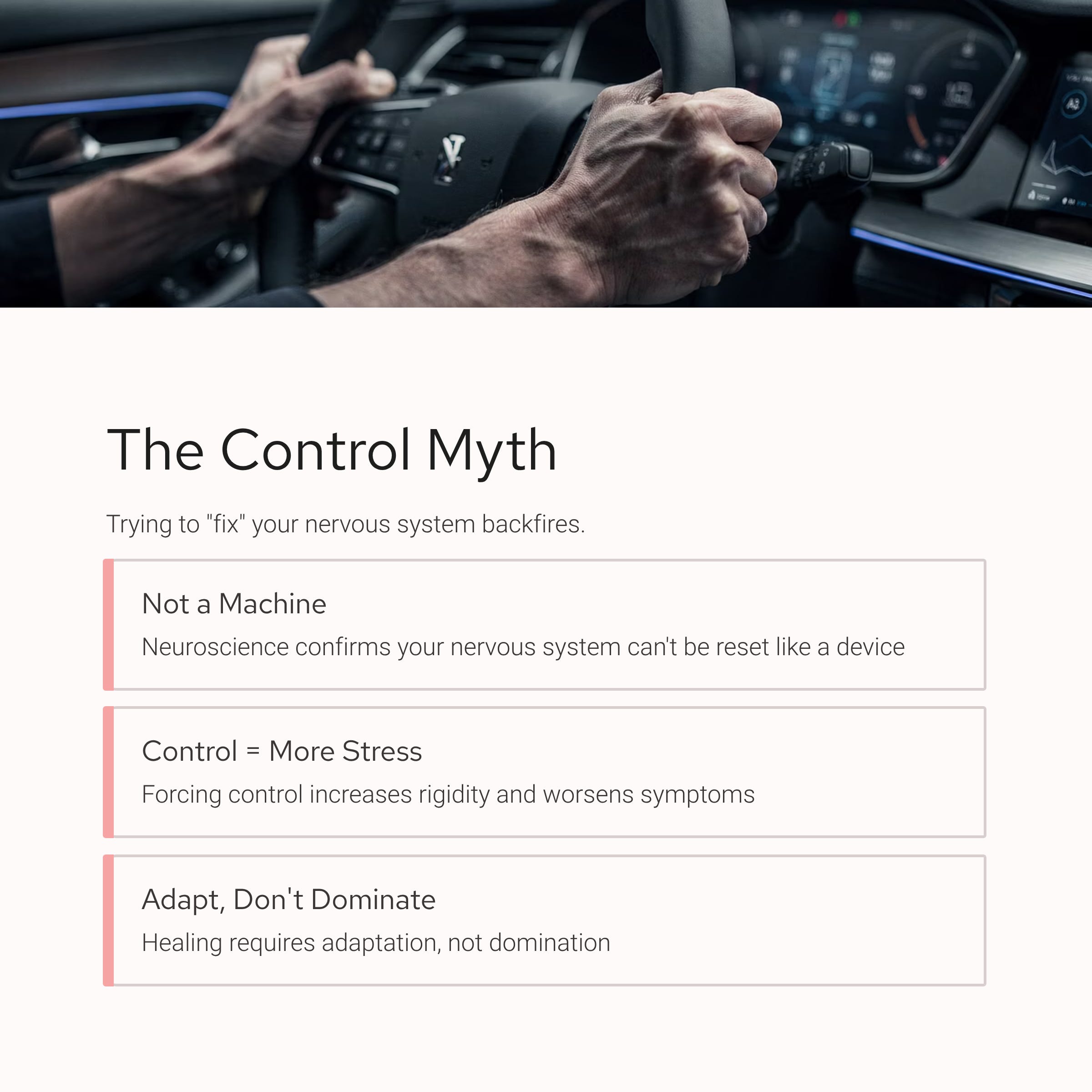
The nervous system calms down not when experience becomes predictable, but when unpredictability stops feeling like danger.
A dysregulated nervous system is, at its most basic level, a prediction system biased toward threat. It is constantly asking: Is this safe? Is this manageable? Is something about to go wrong? When uncertainty is interpreted as risk, the body mobilizes. Heart rate shifts. Muscles brace. Attention narrows. Thought accelerates. The organism prepares for action, whether or not action is actually required.
Under such conditions, stillness can feel unbearable. Calm can feel suspicious. The absence of stimulation may even feel like a problem to be solved.
Control becomes the reflexive strategy — an attempt to impose order on an internal world that feels unstable.
Unfortunately, the nervous system is not particularly persuaded by this tactic.
Participants in the meditation research described something subtle but profound: over time, deliberate exposure to fluctuating internal experiences reduced their sense of alarm. Unusual sensations felt less alien. Emotional intensity became less threatening. The mind developed a different relationship to instability — not because disturbance vanished, but because disturbance ceased to automatically imply danger.
This distinction is critical.
Stability is not the absence of disturbance.
It is the capacity to remain coherent in the face of a disturbance.
Rigid systems break under pressure. Flexible systems absorb.
Trying to control experience is often the nervous system’s way of announcing that it does not feel safe inside experience.
Much of what modern-day society and culture (myself included) use the term 'stress management', yet it fails because it misunderstands the target. People attempt to control thoughts when the underlying physiology is already activated. They attempt to reason their way into calm while stress chemistry continues circulating. They attempt to suppress signals that are, from the body’s perspective, entirely logical responses to perceived threat.
My entire career has been based on this effort, and it's been completely sincere, yet the further I get into the research and my recovery from dysautonomia, I've realized
that my sequence is backwards.
The nervous system reorganizes through safety, repetition, and survivable exposure to internal variability. It gradually learns that activation rises and falls, that sensations change, and that discomfort does not necessarily require emergency measures. Over time, the range of tolerable states widens. What once triggered alarm becomes simply another fluctuation in experience.
This process looks unimpressive from the outside. No dramatic breakthroughs. No cinematic revelations. Just the slow, almost boring expansion of capacity.
Biology is rarely theatrical.
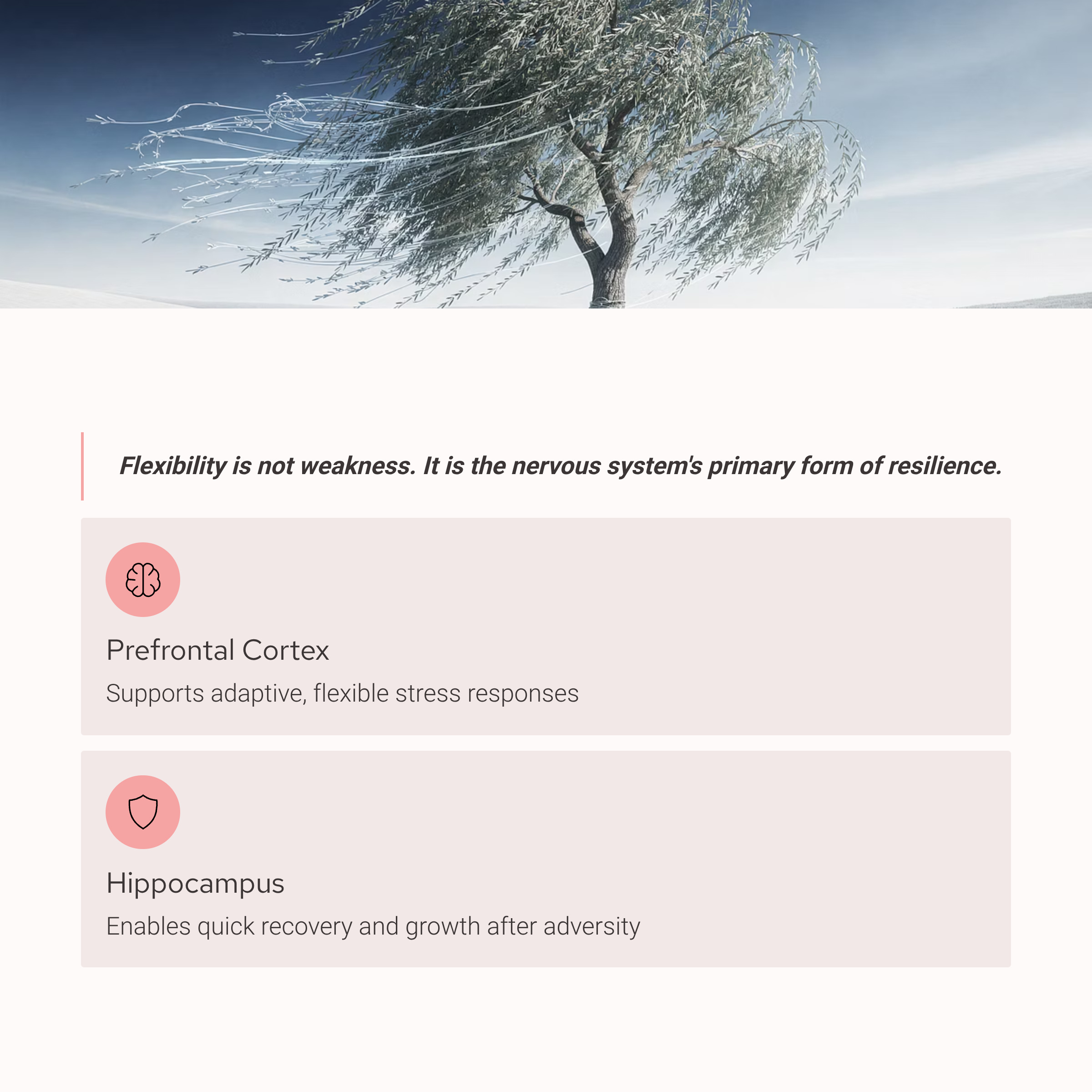
Flexibility is not weakness. It is the nervous system’s primary form of resilience.
There is also a deeply human reason control strategies persist. Control offers the illusion of certainty. It promises that with sufficient effort, unpredictability can be neutralized. That discomfort can be engineered away. That the mind can be trained into permanent tranquility, which it cannot.
Real regulation is less glamorous.
It requires allowing moments of restlessness without immediate correction. Allowing waves of activation without assuming catastrophe. Allowing thoughts, sensations, emotions — the entire messy weather system of being human — to move without treating each fluctuation as a malfunction.
The nervous system does not need a perfectly controlled environment.
It needs repeated evidence that experience itself is survivable.
Which, admittedly, is a less marketable message, trust me on this.
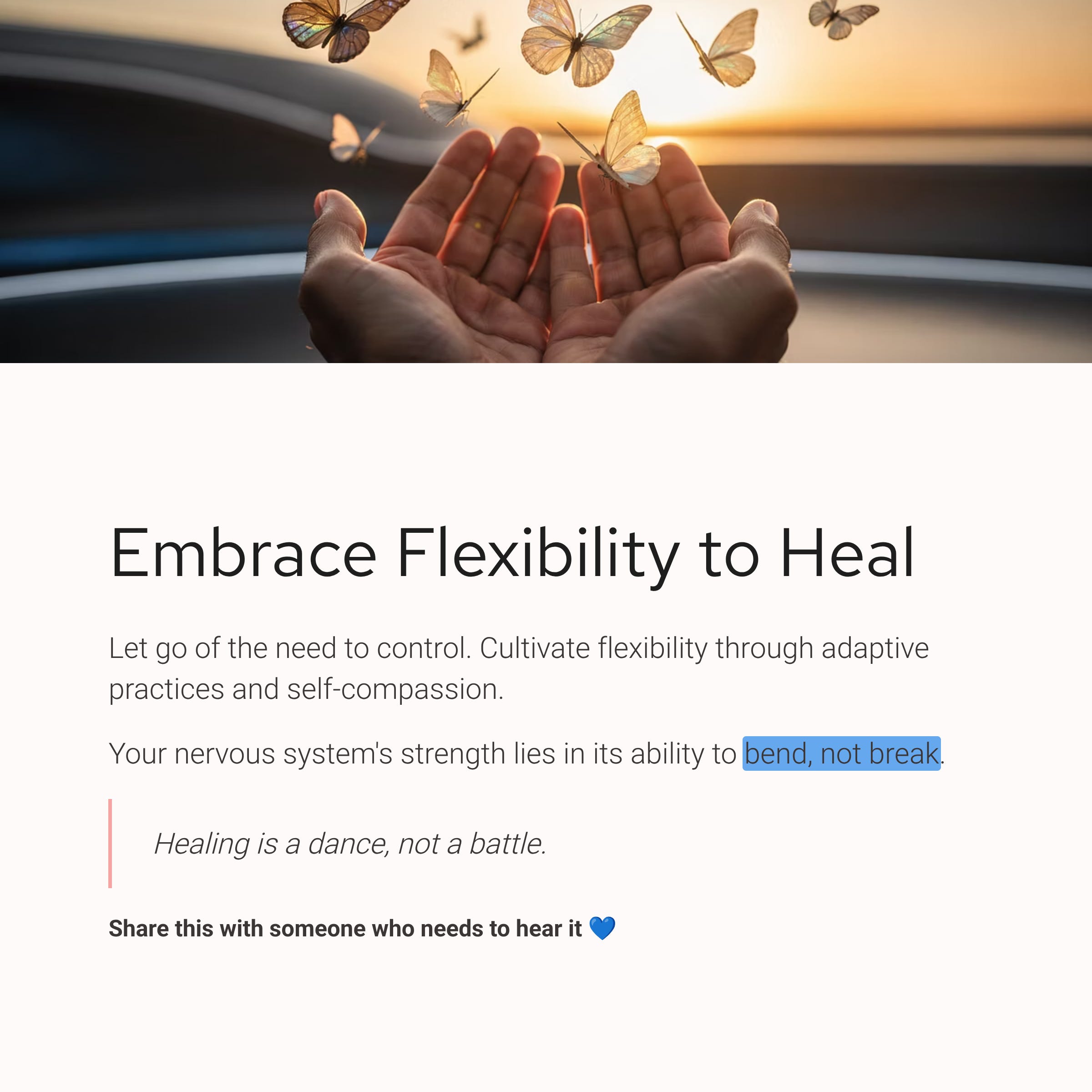
What emerges from this perspective is not passivity but a different form of intelligence. A recognition that stability grows from capacity rather than suppression. That safety is learned through contact, not avoidance. That the body often needs permission to experience variability before the mind can experience ease.
Or, I could state it like this:
The path to regulation is rarely paved with tighter control, so why not just let go?
Ponder this…
What would change if you stopped asking how to control your nervous system — and started asking what conditions allow it to feel safe enough to loosen its grip?
Because your system is not resisting calm.
It is responding to what it believes is necessary for survival.
And biology, inconveniently, is always playing the long game.
Thanks for reading and being with me today.
Cheers.
Lane