

I Thought Celsius Was Helping Me. Nope, It Wasn’t.
For a long time, Celsius felt like a sensible choice, and it tastes delicious.
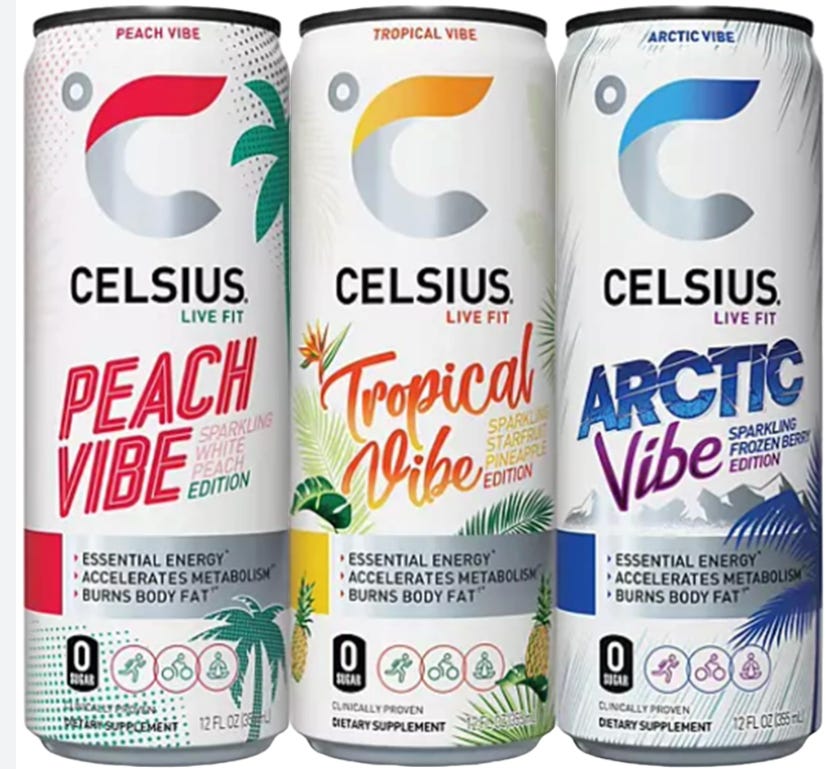
It didn’t carry the cultural baggage of traditional energy drinks. The branding suggested movement, discipline, and health. It is marketed as “clinically proven,” thermogenic rather than reckless. It's the drink you could reach for before a workout or a long drive without feeling like you were doing something obviously harmful.
I drank one most days. Sometimes two.
And for a while, nothing dramatic happened.
Then, in May, my body stopped cooperating

What followed wasn’t a crisis so much as a slow unraveling. My heart became unpredictable. My nervous system has felt permanently on alert. Sleep is fractured. Recovery is very weak. The sense of internal steadiness I relied on—personally and professionally—has been jilted to a degree I didn't even know existed.
I didn’t immediately blame the drink. But once I stopped and looked closely, it became impossible to ignore the role it may have played.
The Illusion of “Clinically Proven”
Celsius Holdings positions its flagship beverage as a healthier alternative in a crowded category. The company points to peer-reviewed studies showing short-term increases in metabolic rate and fat oxidation, and it operates within FDA caffeine guidelines. On the surface, the claims appear responsible.
But the details matter.
Many of the studies used to support Celsius’s marketing were funded by the company itself or by closely affiliated entities involved in its early development. The research is short-term—often lasting weeks—and conducted primarily on healthy, sedentary men. People with cardiovascular issues, metabolic instability, liver concerns, or elevated stress physiology are excluded. Women, teenagers, and long-term daily users are largely absent.
This does not make the science fraudulent. It makes it incomplete.
What the research demonstrates is that Celsius can temporarily stimulate metabolism. What it does not tell us is what happens when that stimulation becomes habitual—especially in bodies already operating under chronic stress, which, at this point, is nearly all of humanity unless you're living under a rock.
Caffeine Is Not Neutral Biology
A single can of Celsius contains between 200 and 270 milligrams of caffeine, depending on the formulation. That number is often compared to two or three cups of coffee, an analogy meant to reassure, to make you feel like it's okay to guzzle the can. The FDA’s guidance states that up to 400 milligrams per day is “generally safe” and is frequently cited as proof that concern is unnecessary. This is so absurd!
What that framing overlooks is variability.
Caffeine metabolism is strongly influenced by genetic differences, particularly in the CYP1A2 enzyme. Slow metabolizers break down caffeine more gradually, leading to higher circulating levels for longer periods. For individuals like this (including me), it appears that moderate levels on paper can translate into prolonged nervous system activation, cardiovascular strain, and sleep disruption.
I'm not a unique butterfly when it comes to this SNP. A significant portion of the population falls into slower-metabolizing categories. Yet genetic variability is absent from Celsius’s safety messaging. The product is marketed as broadly safe, but in reality it interacts very differently depending on the body that consumes it.
For some people, a can of Celsius is a brief lift. For others, it is sustained physiological stress.
What’s Inside—and What Isn’t Disclosed
Caffeine in Celsius does not come solely from synthetic sources. Guarana, a plant containing naturally occurring caffeine, is included in the formula. Because of labeling conventions, this additional stimulant load is not always clearly quantified for consumers.
Green tea extract, included for its thermogenic effects, contains EGCG, a compound that has been linked in medical literature to liver toxicity at high or repeated doses when concentrated. Celsius does not disclose exact EGCG amounts, making cumulative exposure difficult to assess for daily users.
Sucralose, the drink’s sweetener, has been associated in animal and emerging human studies with changes to the gut microbiome. The long-term implications remain under investigation, but uncertainty itself matters in a product framed as health-forward.
None of these ingredients are inherently dangerous in isolation. The concern lies in repetition, combination, and context.

Where DNA, Nutrition, and Stress Intersect
What ultimately shifted my thinking was not the ingredient list alone, but the realization that energy drinks do not interact with a generic human body. They interact with a nervous system shaped by genetics, nutritional status, and your cumulative stress.
Stimulants increase demand on systems responsible for detoxification, neurotransmitter balance, and electrolyte regulation. When those systems are already strained—by poor sleep, under-eating, illness, hormonal changes, or chronic psychological stress—caffeine does not simply “provide energy.” It borrows capacity. (You can learn more about this in my Calm Lab)
Repeated sympathetic activation can suppress heart rate variability, destabilize blood sugar, and disrupt cortisol signaling. Over time, the body’s ability to return to baseline erodes. What begins as stimulation starts to feel like fragility.
This is why two people can consume the same product with vastly different outcomes. One feels focused and energized. The other feels anxious, inflamed, or depleted days later. The difference is not discipline or mindset. It is biology meeting context.
I don't think Energy drinks are discussed this way because it complicates the narrative. It requires acknowledging that stress physiology and genetic variability matter more than branding.

A Regulatory Comfort Zone
Celsius benefits from regulatory frameworks that treat plant-based stimulants differently from isolated caffeine. By relying on guarana, the product navigates thresholds that allow for higher stimulant exposure without triggering formal limits in athletic settings.
This may be legally sound. It is not biologically neutral.
Research funded by the company emphasizes acute performance and thermogenesis. What remains largely unexplored is the long-term impact of daily nervous system stimulation in a population already living under unprecedented stress.
Listening Before the Body Shouts
My experience is not unique. Cardiology journals have documented cases of caffeine-induced arrhythmias, often in individuals without known heart disease. These cases rarely involve extreme doses. More often, they arise from cumulative exposure in susceptible bodies.
Celsius did not “break” my system.
It amplified signals that were already there—and that I had learned to override.
The drink meets regulatory standards. But standards are designed for populations, not individuals. They assume average metabolism, average stress, average resilience.
Very few of us are average anymore.
The Question Worth Asking
I'm not writing this to argue for a ban on energy drinks. It is an argument for honesty.
What would change if products like Celsius were evaluated not only for short-term performance, but for how they interact with stress physiology, genetic variability, and long-term regulation? What if “clinically proven” meant more than temporarily increasing output?
For me, stopping was not an act of discipline. It was an act of attention.
The body does not whisper forever. Eventually, it raises its voice and you're forced to listen.
The challenge is learning to listen—before stimulation masquerades as strength.