

Part Two of Five
One of the most unsettling truths about high-control groups — whether they are self-help programs, spiritual communities, or modern wellness collectives — is that the shift from support to control rarely arrives as a dramatic rupture. Sociologists like Janja Lalich, who has spent decades studying these environments, often describe the turning point as “a subtle tightening of the net.” You overlook the constraints until you try to be different.
For nearly two years, I supported (meaning: I received minimum compensation for a few months, then volunteered for several months) inside a large well-known private online wellness community led by a charismatic male figure who combined biohacking bravado with spiritual ascension rhetoric (aka spiritual bullsh*t) — a blend that cult researchers call “conspirituality,” the merging of self-help spirituality with quasi-authoritarian certainty. The term was first introduced by social scientists Charlotte Ward and David Voas, who noted its rise in wellness spaces where personal healing becomes intertwined with ideological loyalty.
I didn’t see the control at first. I came in as a practitioner, a functional DNA nutritionist who specializes in genetics, stress physiology, and the autonomic nervous system. I believed I was offering something meaningful. And for a long time, it felt reciprocal: I brought depth, nuance, science, and an alternative opinion; the community brought connection. The leader invited me into meetings and a closed private chat, where he yelled in all caps, used obscene language about members, and pontificated about going beyond 5D and how he had seen it all and been there. At first, we bonded; at first, I thought, he gets me. At first I thought, I get him!

After several months of being in the inner circle, one morning, everything shifted.
I collapsed at my gym and ended up in the emergency room. I was completely dysregulated, with my vision blurred, heart racing, and body shaking, to say the least, it was horrible. Two EKGs, a CT scan, and a bag of hydration later, I was released, still shaking and still unregulated. I posted in the group, sharing an image of myself in the ER (which you will see in tomorrow’s post) with a message saying, "Don't let this happen to you," and added, "Make sure to listen to the whispers of our inner voice, which often go unheeded.”
I couldn't participate in the group; I could not look at the screen. I was shaking and and my body shut down on me. A friend messaged me that members were sending well wishes and hoping for a quick recovery—the founder of the group —the one and only — who I thought would have messaged me —said nothing, no word. Weeks went by, and my body continued to be shut down; I slept. No email, no phone call, no private texts. Nada.
An Email That Tilted My Nervous System
Before my collapse, there was a pivotal message from the leader of the group, delivered to my inbox, so casually it almost felt benign — an email telling me,
“Stay in your lane!
I will use WHATEVER WORDS I CHOOSE WHENEVER I CHOSE THEM!
Are we clear?
We better be!
I AM sending you my love, light and deepest gratitude,”
XXX
On the surface, it was positioned as guidance. But the subtext was unmistakably corrective and coercive. Let me break it down a bit
“Stay in your lane!”
That’s not subtle.
That’s a boundary-as-a-weapon, not a boundary-as-information.
It’s directional control — telling you where you’re allowed to exist in the relational space.
“I will use WHATEVER WORDS I CHOOSE WHENEVER I CHOOSE THEM!”
This is pure dominance energy.
Volume implied, power asserted, relational hierarchy declared. When someone needs to shout about their autonomy, it usually means: they’re actually trying to override yours.
“Are we clear? We better be!”
Pure coercion yet with a bow on it!
This is the linguistic equivalent of someone poking a finger in your sternum and saying, “Agree with me or else.”
“I AM sending you my love, light, and deepest gratitude”
Ah yes, the classic spiritual bypassing chaser.
This is how controlling people wash down aggression with cosmic glitter.
The contrast between the controlling language and the performative love-and-light sign-off isn’t accidental — it’s part of the confusing double-bind.
He was not hearing my ideas or suggestions; it was his way or no way. Researchers who study emotional coercion often cite these moments — what psychologist Margaret Singer called “micro-indoctrinations” — as early markers of control. They are corrections disguised as care, an attempt to move you back into your assigned role. When he sent this, I knew it wasn't right, and I put it to the side.
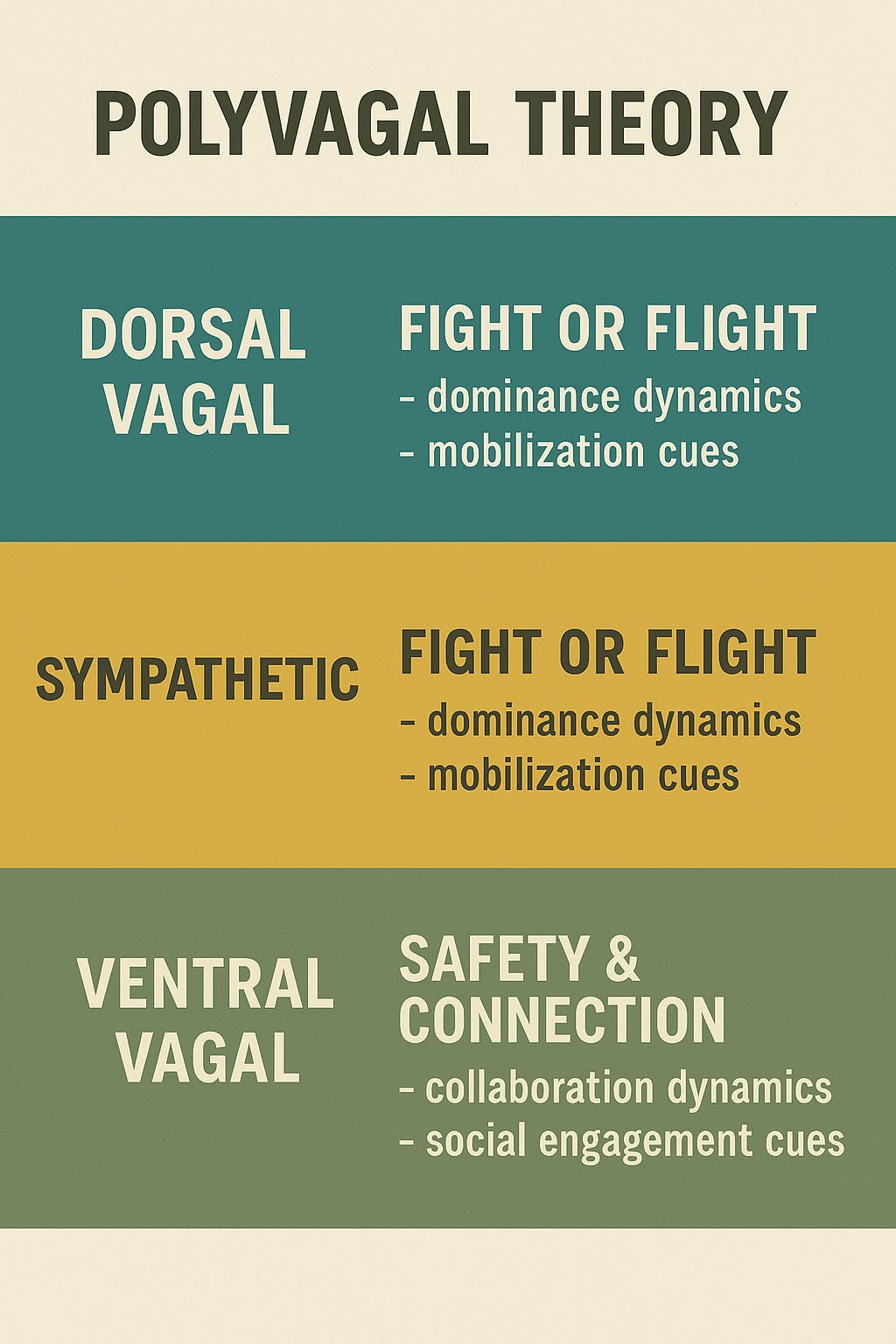
According to neuroscientist Stephen Porges, whose Polyvagal Theory reshaped our understanding of stress responses, the nervous system destabilizes not just from physical threat but from relational threat — being corrected, dismissed, or subtly shamed by someone perceived as safe.
That email wasn’t the cause of my landing in the ER. But it was part of the destabilizing spiral. A fiery spark that landed on my already overloaded system.
That was just one moment among countless interactions I navigated weekly.
Within days of my collapse, my vision got worse, my blood pressure tanked, and I slid into what trauma clinicians call dorsal vagal shutdown — the body’s oldest survival mechanism. Bessel van der Kolk, author of The Body Keeps the Score, has written extensively about how the autonomic nervous system collapses when emotional overwhelm exceeds perceived internal resources.
I wasn’t manifesting misalignment.
I was having a full-blown medical crisis.
So yes — I ended up in the emergency room. Not because I wanted attention, but because my body was giving out and I didn’t know what else to do.
Then The Leader’s Wife Calls — And The Tone Changes
It wasn’t the leader (who called to check on me). It never is, as cult researcher Alexandra Stein notes: leaders stay insulated, protected by inner circles who enforce the ideology. It was his wife — someone I trusted — sending a message that landed like a blow.
She led the call with, "I just want to make sure that the intention of the call is not to come from emotion, but that it comes from us just being as logical and observational as possible. Because that’s the one thing I appreciate about both of us: we’re both looking at ways to improve. So I just wanted to keep it on that level."
She continued to say my ER post I shared within the group “wasn’t in sync with what he teaches.”
That the photo had “the wrong energy.”
That vulnerability, like this, could “confuse the group.”
This kind of reframing is classic emotional minimization. Sociologist Dr. Paula Sweet, who studies gaslighting, describes it as “a denial of the victim’s reality through benevolent language.” It’s not overt cruelty; it’s a subtle rewriting of your experience into something problematic.
“I just want to keep this call logical, not emotional.”
Who talks like that? Who talks like that to someone who has been supporting their business, and running behind the scenes, making sure that the community was functioning and running smoothly? (And yes, when I collapsed and posted, I was volunteering, not being paid!).
Psychologists will tell you this is a red flag. It’s a conversational tactic that preemptively delegitimizes the other person’s emotional reality — a maneuver documented by trauma therapist Pete Walker, who calls it “emotional invalidation disguised as rationality.”
From there, the conversation followed a script I have since learned is common in high-control wellness spaces: (her words)
“You reacted emotionally.”
“You were defensive.”
“You disappeared.”
“You’re misaligned.”
“This doesn’t reflect his (the leader/her husband) philosophy.”
Every statement subtly positioned her as the rational authority and me as the dysregulated, out-of-sorts problem.
Here’s what the research shows:
When someone is in medical distress, emotional dysregulation isn’t a moral failure — it’s biology.
Interpersonal invalidation during a vulnerable moment can trigger a deep autonomic crash. As UCLA neuroscientist Naomi Eisenberger found, social rejection lights up the same neural circuitry as physical pain. It is not metaphorical harm. It is literal harm.
The Wellness Policing Begins
She told me I should have responded differently. More calmly. That my post could “worry” people. That illness wasn’t in alignment with the group’s teachings. That I needed to be mindful of how I represented myself, given my role.
In short:
My truth was inconvenient.
My body was disruptive.
My vulnerability was off-brand.
This aligns with what cult scholars describe as “bounded choice,” a concept developed by Janja Lalich. Inside a high-control group, the ideology becomes self-sealing. Whatever you do is either aligned or it isn’t, and anything “misaligned” becomes a character flaw, not a critique of the system.
This Wasn’t My First Encounter With Cultish Dynamics — Just the Most Personal
The patterns were familiar.
I had watched friends get emotionally chewed up by The Forum back in the 90s — a program Margaret Singer wrote extensively about in her research on coercive persuasion. They returned from training euphoric, convinced they’d reached radical clarity. But as Singer noted, such clarity often results from controlled environments that collapse critical thinking.
I saw similar dynamics in the early Bulletproof Coaching program — a culture that, as sociologist Deborah Lupton might argue, merged self-optimization with moral identity. When “betterment” becomes a virtue, anything less becomes a flaw.
I saw the same tendencies at a Bryan Johnson Blueprint event in San Francisco, where men wore their “sheeple” T-shirts like armor and treated longevity protocols as scripture. This reflects what philosopher Byung-Chul Han describes as “achievement ideology”: the belief that perfection is possible if only the body is controlled tightly enough.
So no — I wasn’t naïve.
I was simply unguarded.
I believed that serving a community would protect me from becoming a target.
But service is not protection in these systems.
It is currency — until it isn’t.

The Anatomy of Control, According to the Research
Once I stepped back, the pattern was textbook:
The leader becomes doctrine.
As Singer noted, dissent isn’t disagreement — it’s “misunderstanding the teachings.”
Moderators act as enforcers.
They are warm, but they police behavior. This is what Alexandra Stein calls “attachment-based control.”
Vulnerability is dangerous.
According to cult researchers, real human suffering threatens the group’s illusion of transcendent wellness.
Your reactions are reframed as flaws.
Paula Sweet calls this “interpretive gaslighting.”
Communication becomes correction.
You aren’t spoken with; you’re spoken at.
Women are disposable once they stop being convenient.
Sociologist Janja Lalich notes this is nearly universal.
NOTE: I Didn’t Leave the Group —
The Group Left Me When I Became Inconvenient
That is the truth wellness culture rarely admits.
You are safe as long as you support the narrative.
You are valued as long as your story is brand-compatible.
You are welcome as long as you don’t expose the limits of the ideology.
But the moment you become human — vulnerable, flawed, dysregulated, ill — the tone shifts.
This is not support. This is control.
And as trauma experts like Bessel van der Kolk remind us:
“Trauma is not what happened — it’s what happens inside you when you feel alone in your pain.”
I wasn’t alone. But I was treated like I should be!
Part Three will zoom out even further — into the psychological, cultural, and physiological harm these groups create, often without ever calling themselves what they truly resemble.
Yeah. You know I know. How are you doing these days, Lane? He's an extreme but I see versions of him across the wellness space. Nick Norwitz. Keto guy. Rising YouTube star. Within 60 seconds of seeing a Substack comment of mine that challenged his narrative it was immediately deleted. There is to no questioning of the leader. I don't get it. I just posted my artery scans online and I intend to hound all these wellnesd leaders for refusing to do the same. They never, ever, want to be personally accountable to their sheep followers for anything. They are story-tellers who gather children around the campfire to tell the story to, and to profit from. And the children feel warm and fuzzy.
Oh my gosh what an ordeal! I haven’t ever been in this situation, but holy hell I’m so glad you are on the other side of it now. I’m so curious as to who the wellness guru is.. I got beachbody and Tony whatever his last name is vibes. That whole industry came off as gross to me.
I’m so glad you were able to put this all in an article! Writing is so therapeutic!